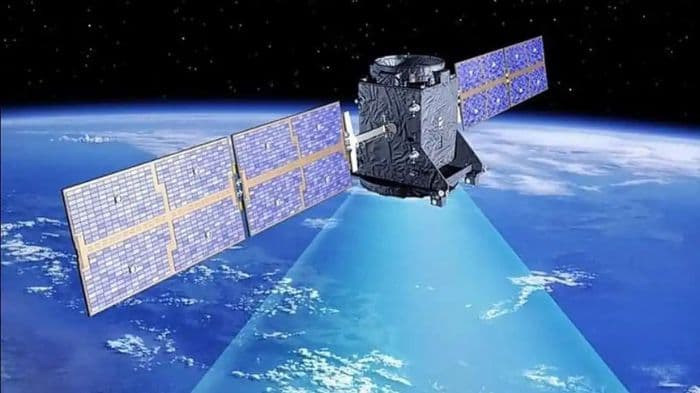
India is developing a plan to deploy so-called “bodyguard” satellites to protect its orbiting spacecraft from threats, according to media reports. The proposal follows a near-miss in orbit that highlighted risks to national security posed by other satellites.
The incident, which had not been publicly reported until now, involved an ISRO satellite orbiting at about 500-600 kilometres altitude. Another satellite from a neighbouring country, unnamed in reports came within 1 kilometre of India’s satellite while it was performing tasks such as ground monitoring and mapping.

Collision was avoided, but sources said the close approach was “unusually close” and possibly a test of capability.
In response, under Prime Minister Narendra Modi’s government, India is now considering a satellite-protection project which includes “bodyguard” satellites, aimed at identifying and countering threats in orbit.
The plan is part of a larger Rs 27,000-crore (~US $3 billion) initiative to deploy about 50 surveillance satellites, with the first expected to be launched next year.
These “bodyguard” satellites may include Light Detection and Ranging (LiDAR) satellites to detect threats more rapidly. They would operate alongside ground-based radars and telescopes to enable around-the-clock tracking and monitoring.
Sudheer Kumar N, former ISRO capacity-building director, said that India currently does not have in-orbit tracking capability on a 24×7 basis, but some startups are working on solutions.
Officials and sources say that ISRO and the Department of Space have not yet publicly responded to requests for comment.
The initiative reflects growing concerns about space traffic, satellite crowding (including from constellations such as Starlink), and the possibility that close approaches could become more frequent.
The planned surveillance satellites are expected to support India’s monitoring, communications, and security needs in space.
As India continues to expand its space assets, strategies to protect those assets are emerging as a higher priority for policymakers.







.webp&w=256&q=75)


.webp&w=256&q=75)
