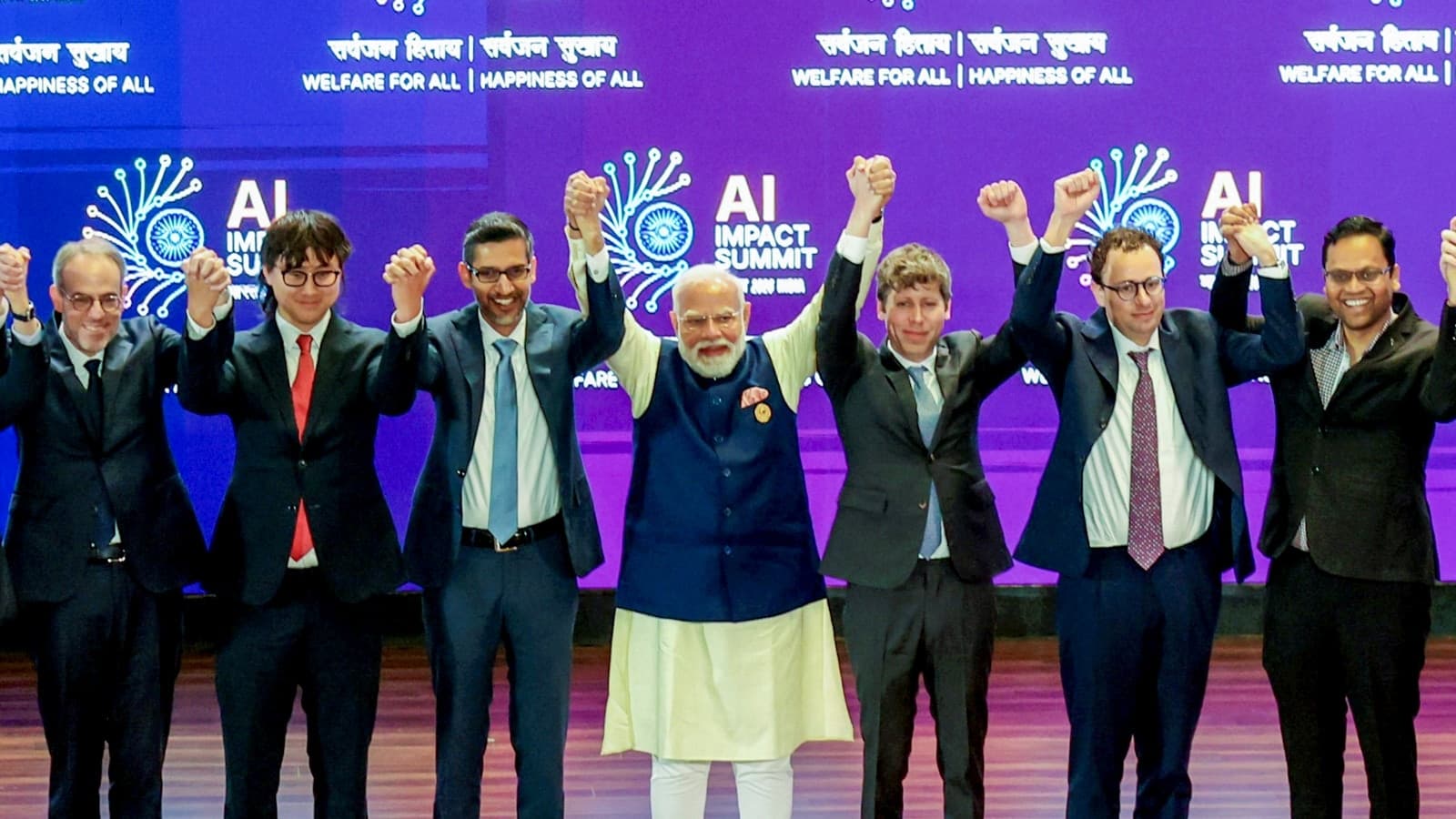
In a significant diplomatic breakthrough, India secured the backing of 88 countries and international organizations — including the United States, China, France, Australia and the United Kingdom — for the ‘New Delhi Declaration on AI Impact’, the centrepiece outcome of the five-day India AI Impact Summit.
The sweeping endorsement positions India at the heart of a rapidly evolving global conversation on artificial intelligence (AI), even as the commitments remain voluntary in nature.

The declaration outlines a structured push toward what India calls the “democratic diffusion” of AI — an attempt to counter the concentration of advanced AI capabilities in the hands of a few companies and countries in the West. Government officials said the framework balances open access with national sovereignty, allowing countries to shape AI ecosystems in line with domestic laws and priorities.
A diplomatic reversal
The consensus marks a notable shift from last year’s AI Action Summit in Paris, where the US and the UK had declined to sign a similar declaration, with Washington raising concerns over Europe’s regulatory-heavy approach to AI. This time, both countries joined China and others in endorsing India’s framework.
Even the European Union — which initially expressed reservations over language echoing certain UN charters — ultimately signed on, recognizing India as a critical trade and technology partner.
Charter for democratic diffusion
At the heart of the declaration is a “Charter for the Democratic Diffusion of AI”. Signatories have agreed to promote access to foundational AI resources, encourage locally relevant innovation, and build resilient AI ecosystems while respecting national laws.
The document underscores that wide-scale AI adoption carries unprecedented potential to drive economic and social development. It calls for open-source AI models and accessible frameworks, where appropriate, to enable scalability, replicability and cross-sector adaptability.
Global platforms and shared infrastructure
The declaration endorses multiple voluntary collaborative mechanisms:
- Global AI Impact Commons — a practical platform to share, replicate and scale successful AI use cases across regions.
- Trusted AI Commons — a repository of technical tools, benchmarks and best practices aimed at strengthening security, transparency and public trust in AI systems.
- International Network of AI for Science Institutions — a cross-border research platform to pool AI infrastructure and scientific capabilities, accelerating AI-driven discoveries.
Together, these initiatives aim to remove structural barriers to AI research and expand access to computing resources, data and expertise — long dominated by a handful of tech powerhouses.
Focus on social empowerment and jobs
Beyond technology governance, the declaration places emphasis on social inclusion. It highlights AI’s potential to widen access to knowledge, services and economic opportunities, particularly in developing economies.
Signatories have endorsed voluntary guiding principles for reskilling in the age of AI, alongside a workforce development playbook to prepare societies for an AI-driven economy. The document also notes “Voluntary Guiding Principles on Resilient, Innovative, and Efficient Artificial Intelligence” to promote responsible lifecycle management of AI systems.
The real test ahead
While the breadth of participation marks a diplomatic win for India, implementation remains the central challenge. All commitments under the declaration are voluntary, with no binding enforcement mechanisms.
The coming months will test whether the coalition can translate consensus into coordinated action — and whether India’s vision of democratized AI can meaningfully reshape a global ecosystem currently defined by technological concentration and strategic rivalry.






.jfif&w=256&q=75)





.webp&w=256&q=75)
