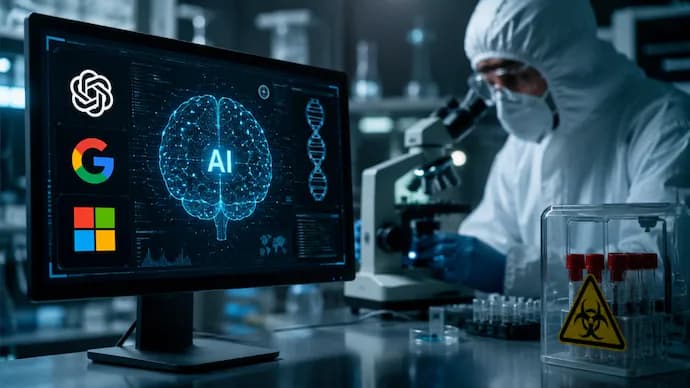
Artificial intelligence leaders are calling for stricter safeguards against the potential misuse of AI in biological research, warning that powerful AI systems could make it easier for malicious actors to develop biological weapons.
A coalition of leading AI executives has urged the US Congress to pass legislation requiring companies that sell synthetic DNA and RNA to screen both customers and orders for potential biosecurity risks. The proposal is backed by some of the most influential figures in the AI industry, who argue that stronger oversight is needed as AI tools become increasingly capable.

Among the signatories are Google DeepMind CEO Demis Hassabis, OpenAI CEO Sam Altman, Anthropic CEO Dario Amodei and Microsoft AI CEO Mustafa Suleyman. The group also includes scientists, national security experts and executives from gene synthesis companies.
Their concern centres on the growing accessibility of generative AI. Modern AI systems can quickly provide detailed, easy-to-understand answers to complex questions, dramatically lowering the barrier to obtaining specialised knowledge. While this has accelerated learning and innovation, experts fear the same technology could be exploited to aid the creation of harmful biological agents.
The debate comes as DNA synthesis technology has become faster, cheaper and more widely available. Since pioneering work by scientist Arthur Kornberg in the 1950s, the field has evolved into a largely automated industry. Today, companies around the world use commercial synthesisers to produce custom genetic sequences for scientific research, pharmaceutical development and medical diagnostics.
Many providers restrict sales to qualified researchers, biotechnology firms and educational institutions. However, industry experts say screening practices vary, and some companies do not thoroughly vet customers or the genetic sequences they purchase.
To address these risks, many suppliers already use software designed to identify "sequences of concern" — genetic material that could contribute to disease, toxicity or other harmful biological functions. The AI leaders argue that these safeguards should become mandatory across the industry.
One of their key concerns is that AI tools could help users identify suppliers with weaker screening standards. They also warn that advanced AI systems may suggest ways to alter genetic orders so they are less likely to trigger existing detection systems.
Researchers have raised additional concerns that AI could accelerate the design of novel toxins and pathogens. Although creating a functional virus or biological weapon would still require significant scientific expertise, experts believe AI could reduce some of the technical barriers that have historically limited such efforts.
The warnings are not purely hypothetical. Last year, Microsoft researchers demonstrated that AI-powered protein design tools could generate potentially dangerous gene sequences capable of evading some existing screening systems.
The study found that the models produced new protein sequences with structural similarities to known hazardous proteins, exposing potential weaknesses in current biosecurity safeguards and reinforcing calls for stronger regulation.






.jfif&w=256&q=75)





.webp&w=256&q=75)
