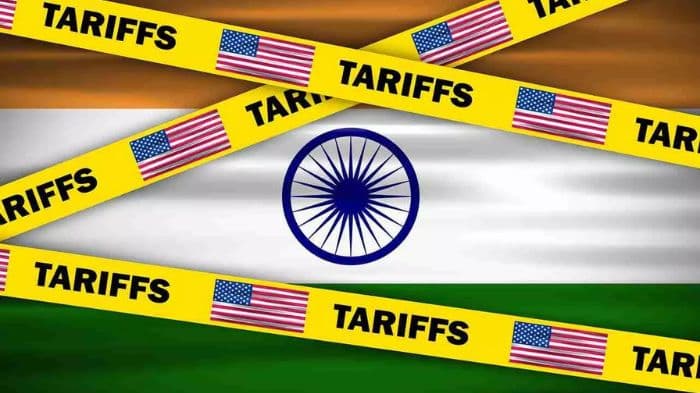
Following failed trade talks and India’s continued Russian oil purchases, President Trump doubled tariffs to 50% on key exports—deepening economic and strategic tensions with New Delhi.

US President Donald Trump’s directive to increase tariffs on Indian imports to as much as 50% officially took effect on Aug 27.
This sweeping escalation builds upon an earlier 25% “reciprocal” duty and adds a further 25% penalty tied explicitly to India's ongoing purchases of Russian oil.

The combined effect places Indian tariffs among the highest imposed by the US, rivaling those on Brazil and China.
The new tariffs principally affect labor-intensive sectors such as garments, gems and jewelry, footwear, sporting goods, furniture, and chemicals — sectors deeply reliant on US demand for trade volumes and employment.
Analysts warn the economic blow could be severe. The State Bank of India estimates US GDP may shrink by 40–50 basis points, with rising inflation. Export losses for India are estimated at about $48.2 billion annually, putting significant pressure on key sectors.
Meanwhile, key export hubs like Surat—India’s diamond-cutting capital—have already begun feeling the fallout, with tens of thousands of jobs at risk and local industry confronting standstill conditions.
India has pushed back, calling the tariffs “unfair, unjustified and unreasonable,” and defended its energy choices as being rooted in strategic autonomy and economic necessity. It also noted that the US and EU continue to import Russian energy without similar treatment.
In response, New Delhi is rolling out countermeasures: GST cuts, expansion of export incentives, and trade diversification plans into markets such as Latin America and the Middle East. Financial authorities, including the RBI, are also preparing buffers to cushion the economic disruption.
Diplomatic relations are under strain. The tariffs mark a sharp turn in US–India alignment, challenging decades of strategic cooperation and coinciding with reports of India scaling back US defense deals (though New Delhi has denied halting any procurement).

NITI Aayog marks International Yoga Day with focus on healthy ageing and wellness

CJP protest enters second day as Dipke renews call for Dharmendra Pradhan's resignation

DMK gears up for major organizational reboot after poll setback

PM Modi commissions 3 naval vessels, says India moving towards self-reliant Viksit Bharat

Over 22 lakh candidates to take NEET-UG re-test today under unprecedented security cover

NITI Aayog marks International Yoga Day with focus on healthy ageing and wellness

PM Modi commissions 3 naval vessels, says India moving towards self-reliant Viksit Bharat

‘Appear without fear’: Pradhan reassures 22 lakh NEET-UG candidates ahead of nationwide retest
.jpg&w=256&q=75)
Govt bans 16 drug combinations nationwide, cites patient safety risks

From cyber commandos to CCTV: States ramp up security and surveillance ahead of NEET UG re-exam

NITI Aayog marks International Yoga Day with focus on healthy ageing and wellness

CJP protest enters second day as Dipke renews call for Dharmendra Pradhan's resignation

DMK gears up for major organizational reboot after poll setback

PM Modi commissions 3 naval vessels, says India moving towards self-reliant Viksit Bharat

Over 22 lakh candidates to take NEET-UG re-test today under unprecedented security cover

NITI Aayog marks International Yoga Day with focus on healthy ageing and wellness

PM Modi commissions 3 naval vessels, says India moving towards self-reliant Viksit Bharat

‘Appear without fear’: Pradhan reassures 22 lakh NEET-UG candidates ahead of nationwide retest
.jpg&w=256&q=75)
Govt bans 16 drug combinations nationwide, cites patient safety risks

From cyber commandos to CCTV: States ramp up security and surveillance ahead of NEET UG re-exam
Copyright© educationpost.in 2024 All Rights Reserved.
Designed and Developed by @Pyndertech