Authorities across several states have intensified security and administrative preparations ahead of the NEET UG 2026 re-examination on June 21, as the National Testing Agency (NTA) moves to ensure the smooth conduct of the country's largest medical entrance test for more than 22.79 lakh candidates.
The pen-and-paper examination will be conducted from 2:00 pm to 5:15 pm across 551 cities in India and 14 international locations. Candidates in the PwD/PwBD category who are eligible for compensatory time will be allowed to continue writing until 6:20 pm.

The NTA said more than two lakh personnel, including city coordinators, independent observers, center superintendents, invigilators, police personnel, and district administration officials, have been deployed to oversee the examination process.
More than 5,500 examination centers in India and abroad will be covered under a multi-layered security framework designed to prevent malpractice and maintain examination integrity.
Question papers and examination materials will be transported in GPS-enabled vehicles under police escort, while CCTV cameras linked to centralized control rooms will monitor activities at examination centers.
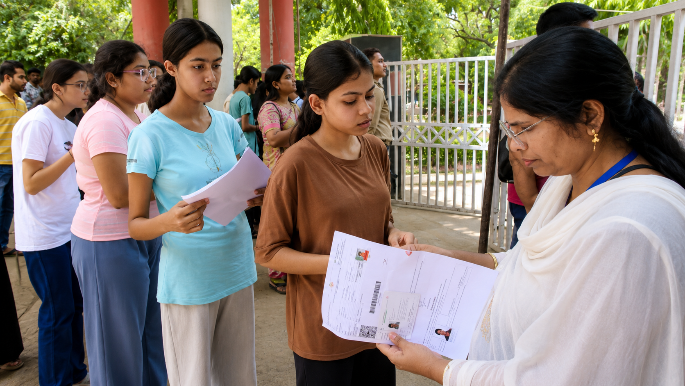
Candidates will undergo Aadhaar-based biometric verification and frisking through high-sensitivity metal detectors before entering examination halls.
The agency has also stepped up monitoring of social media platforms and coordinated with cybercrime authorities, including the Indian Cyber Crime Coordination Centre (I4C) and the Central Bureau of Investigation (CBI), to curb misinformation, fraud, and false claims related to the examination.
NTA clarified that no candidate will be denied entry solely because of biometric authentication failures caused by technical issues, poor fingerprint quality, or connectivity problems.
In such cases, candidates will be required to submit a written undertaking, and manual identity verification will be carried out using valid documents.
Considering the summer weather conditions in many parts of the country, examination centers have been instructed to maintain uninterrupted electricity supply through generators and backup systems.
Drinking water, sanitation facilities, wall clocks, and medical assistance have also been mandated at all centers.
Candidates have been directed to report between 11:00 am and 1:30 pm. Entry gates will close at 1:30 pm, after which no candidate will be permitted to enter.
The NTA has advised candidates to carry a printed admit card, a valid photo identification document, and two passport-sized photographs.
Mobile phones, smartwatches, Bluetooth devices, calculators, wallets, jewelry, metallic accessories, food packets, and other electronic devices will not be allowed inside the centers.
The agency has urged students and parents to ignore rumors regarding question paper leaks or examination irregularities and rely only on official updates available through NTA channels.
Students experiencing examination-related stress have also been advised to use the government's Tele-MANAS mental health helpline.
In Uttarakhand, the Dehradun administration has imposed restrictions under Section 163 of the Bharatiya Nagarik Suraksha Sanhita (BNSS) around examination centers.
The restrictions will remain in force within a 200-meter radius of centers until the conclusion of the examination.
The order prohibits the carrying of weapons, sticks, knives, and other potentially dangerous objects. Authorities have also banned inflammatory speeches, the use of loudspeakers, slogan writing on government property, and the distribution of objectionable material.
Public gatherings, demonstrations, processions, and the movement of vehicles in groups near examination centers have also been restricted.
Officials said violations of the order could attract action under Section 223 of the BNSS.
Several state governments have announced additional measures to support candidates. In Himachal Pradesh, the government has approved free travel for NEET candidates on Himachal Road Transport Corporation (HRTC) ordinary buses from June 20 to June 22.
The decision was taken on the directions of Transport Minister and Deputy Chief Minister Mukesh Agnihotri. Candidates will be entitled to one free journey to their examination center and one free return trip. The NEET admit card will serve as valid proof for availing the benefit.
Officials said the move is intended to help students, particularly those traveling from remote areas, reach examination centers without transportation-related difficulties or additional financial burdens.
In Rajasthan's Alwar district, where nearly 10,000 candidates are expected to appear at 27 centers, authorities have introduced heightened security arrangements.
High-definition CCTV cameras, signal jammers, live monitoring systems, and intensive inspection drives have been deployed ahead of the examination.
All examination centers in the district will be monitored through CCTV surveillance, while signal jammers will block mobile connectivity within approximately 50 meters of examination venues to prevent electronic malpractice.
At Babu Shobharam Government Arts College, the district's largest examination center, 720 candidates will appear across 30 rooms monitored by 38 CCTV cameras. Authorities said the movement of every candidate will be tracked through the surveillance system.
Kendriya Vidyalaya, Moti Doongri, has been designated as a special center for differently-abled candidates, with additional facilities arranged to ensure accessibility and convenience.
Officials have also announced that restroom visits during the examination will be recorded, with exact entry and exit timings documented to enhance transparency and monitoring.
Personnel from the Indo-Tibetan Border Police (ITBP), district police, and administrative departments have been deployed at examination centers, while mobile teams will remain on standby to address emergencies.
In Madhya Pradesh, authorities have implemented an extensive security strategy that combines physical security measures with advanced cyber surveillance.
The re-examination will be conducted at 283 centers across 30 districts, including 32 centers in Bhopal where 13,724 candidates are scheduled to appear.
Question papers are being transported using Indian Air Force aircraft, while their storage locations have been kept confidential. From secure strong rooms, examination materials will be escorted to centers by the Central Reserve Police Force (CRPF).
The state's Cyber Cell has deployed 44 specially trained cyber commandos to monitor social media platforms, websites, and suspicious activity on the deep web during the examination period.
Cyber Cell Superintendent of Police Pranay Nagamanshi said, "We have assigned our cyber commandos across the state. Their job will be to keep an eye on the deep web and the digital world in every possible way."
He added that suspicious content would be removed immediately through designated cyber portals if detected.
"Definitely this is a difficult task, but Cyber Commandos have been trained for this. We hope they will stand up to their training and ensure no such incident takes place," Nagamanshi said.
In Chandigarh, the administration has also finalized extensive arrangements for the examination. Around 3,800 candidates are expected to appear at seven designated centers across the city.
Deputy Commissioner Nishant Kumar Yadav reviewed preparations and directed officials to ensure a fair, secure, and transparent examination process.
Confidential examination materials will be transported under security escort by the Central Armed Police Forces (CAPF), while electronic jammers have been installed at all centers to prevent the use of unauthorized electronic devices.
Authorities have implemented a double-layer frisking system. The first level of screening will be conducted by local police personnel, while a second round will be carried out by a professional agency engaged by the NTA.
Duty magistrates have been deployed at every center to supervise arrangements, maintain law and order, and address any contingencies during the examination.
With nationwide mock drills, expanded surveillance networks, cyber monitoring teams, transport assistance measures, and extensive coordination among state and central agencies, authorities are aiming to conduct the NEET UG 2026 re-examination under one of the most comprehensive security frameworks implemented for a national entrance examination in recent years.




_1600x900.jpg&w=256&q=75)



.jpg&w=256&q=75)
.jpg&w=256&q=75)
