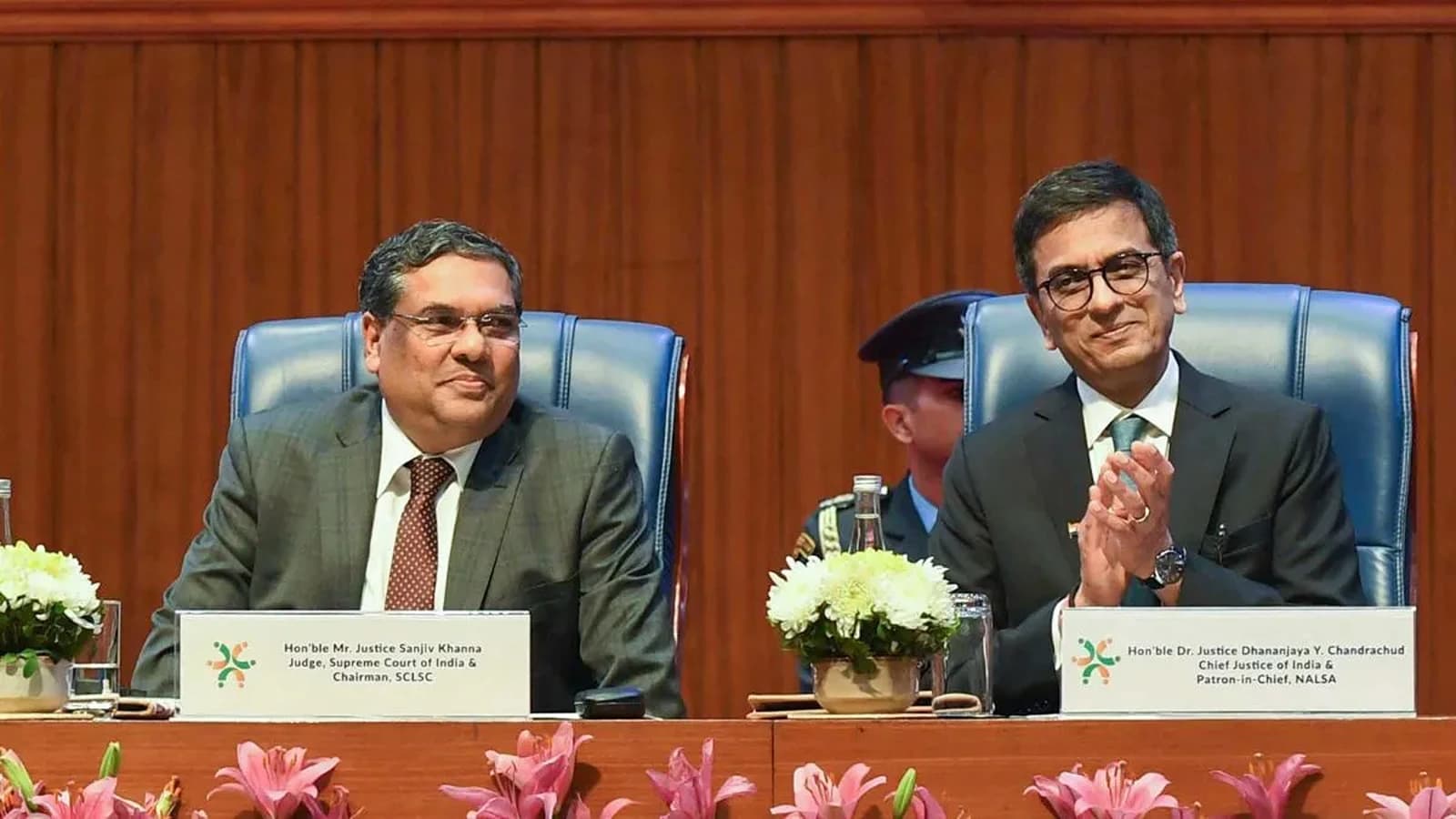
Chief Justice of India (CJI) DY Chandrachud has formally recommended Justice Sanjiv Khanna, currently the second senior-most judge of the Supreme Court, as his successor.
This recommendation follows the customary process where the outgoing CJI proposes the next in line for the position.

CJI Chandrachud, who is scheduled to retire on November 10, 2024, has sent a letter to the Union Government nominating Justice Khanna for the prestigious role.
If the government approves this recommendation, Justice Khanna will assume office as the 51st Chief Justice of India.
His tenure as CJI would span nearly seven months, concluding on May 13, 2025.
Justice Khanna's career trajectory includes his elevation from the Delhi High Court to the Supreme Court in January 2019.
Since then, he has played a key role in shaping significant judgments and contributing to the country’s judiciary.
The transition from CJI Chandrachud to Justice Khanna comes at a pivotal time, with expectations of continued judicial reform and upholding of constitutional values.
About Justice Sanjiv Khanna:
Justice Sanjiv Khanna, currently the second senior-most judge of the Supreme Court of India, has had a distinguished judicial career marked by important contributions to Indian jurisprudence.
Elevated to the Supreme Court in January 2019 from the Delhi High Court, Justice Khanna is recognized for his keen legal insights, progressive judgments, and a commitment to upholding constitutional principles.
Justice Khanna began his legal journey after obtaining his law degree from the University of Delhi and practicing as a lawyer for many years.
He was appointed as a judge of the Delhi High Court in 2005, where he served for nearly 14 years.
His tenure at the Delhi High Court saw him handle a wide array of civil, criminal, and constitutional cases, earning him a reputation as a thoughtful and meticulous judge.
His elevation to the Supreme Court in 2019 was a pivotal moment in his career, coming during a period when judicial appointments were closely scrutinized. His ascent was seen as a reaffirmation of merit and integrity in the judicial system.
Notable Judgments and Contributions
Justice Khanna has been part of several landmark judgments during his time at the Supreme Court.
One of his most notable decisions came as part of the bench that decriminalized consensual same-sex relations in India by reading down Section 377 of the Indian Penal Code.
This judgment was hailed as a significant victory for LGBTQ+ rights in the country.
He has also contributed to important rulings on the right to privacy, environmental law, and economic regulations, demonstrating a progressive approach to civil liberties.
His judgments often reflect a strong emphasis on human rights, transparency in governance, and judicial accountability.
As Justice Khanna prepares to potentially assume the role of the 51st Chief Justice of India, his legacy is already taking shape.
His tenure as a judge has been marked by a dedication to justice and fairness, with decisions that resonate with contemporary societal values.
His understanding of constitutional law, combined with his forward-thinking approach, ensures that he will continue to play a pivotal role in shaping the legal landscape of India.
With a seven-month term ahead as the Chief Justice, Justice Khanna is expected to continue his contributions to judicial reform, with a focus on ensuring accessibility and fairness in the Indian legal system.
His calm demeanor and balanced judgments have made him a respected figure in the judiciary, and his future work as the CJI will likely strengthen this legacy further.