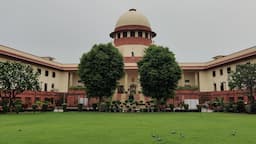
The All India Muslim Personal Law Board (AIMPLB) has told the Supreme Court that Islam places no restriction on women entering mosques to offer prayers, but their access is guided by established religious discipline and traditions, including how entry and prayer spaces are structured.
Appearing before a nine-judge Constitution Bench recently, senior advocate M R Shamshad, representing the Board, said there is “no quarrel” among Muslim denominations over women’s right to enter mosques. However, he stressed that religious practice includes certain “discipline” regarding entry points and prayer arrangements.

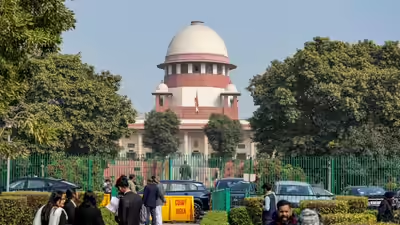
The observations came during hearings linked to constitutional questions arising from the Sabarimala review proceedings, where the Supreme Court is revisiting its September 2018 judgment that struck down restrictions on women’s entry to the Kerala hill shrine.
Court probes religious practice and access
Chief Justice of India Surya Kant, heading the bench, sought clarity on the issue while hearing broader arguments on religious entry rights. “For factual clarity, are women allowed to enter the mosque?” he asked.
The bench — also comprising Justices B V Nagarathna, M M Sundresh, Ahsanuddin Amanullah, Aravind Kumar, Augustine George Masih, Prasanna B Varale, R Mahadevan and Joymalya Bagchi — also noted that the outcome could impact a separate plea filed by a Pune-based couple, Yasmeen Zuber Ahmad Peerzade and Zuber, seeking formal recognition of Muslim women’s right to enter mosques and pray without structural or spatial restrictions.
AIMPLB’s stand on mosque access
Shamshad submitted that while women are permitted to enter mosques, they cannot insist on unrestricted entry through the main entrance or demand absence of separation from men during prayers.
“There is no bar on women entering mosques to pray, but there is a discipline that has to be followed,” he said, adding that Islamic practice does not treat mosques as spaces with a “sanctum sanctorum” where exclusive access or positioning rights can be claimed.
He further argued that petitions seeking directions to allow unrestricted access, including entry through main doors and prayer without physical separation, should be rejected.
Religious practice and tradition highlighted
Responding to questions from the bench, Shamshad referred to Hadith traditions and Islamic teachings, stating that Prophet Muhammad had advised not to prevent women from attending mosques.
“There is consensus among Muslim denominations that women are not required to attend congregational prayers, though they may do so,” he said, adding that prayer at home is considered equally meritorious for women in many interpretations.
He also noted that while attendance at mosque congregations is generally obligatory for men, women are not bound by the same requirement and may pray at home.
Court reflections on social context
Justice Ahsanuddin Amanullah observed that one reason women are not required to attend mosques regularly is practical, noting they may be needed at home to care for children while others attend prayers.
He also emphasized that traditional practices around mosque arrangements have evolved historically since the time of early Islamic traditions.
Case continues next week
The Supreme Court hearing, which forms part of a wider constitutional examination of religious practices and gender rights, is set to continue next week.
The ruling is expected to have wider implications, including on the petition by the Pune couple seeking clearer judicial recognition of women’s access to mosques and prayer spaces.






.png&w=256&q=75)