


SRM University-AP has increased its representation in the prestigious global scientists list from seven faculty members last year to 20 this year, covering six major research domains.
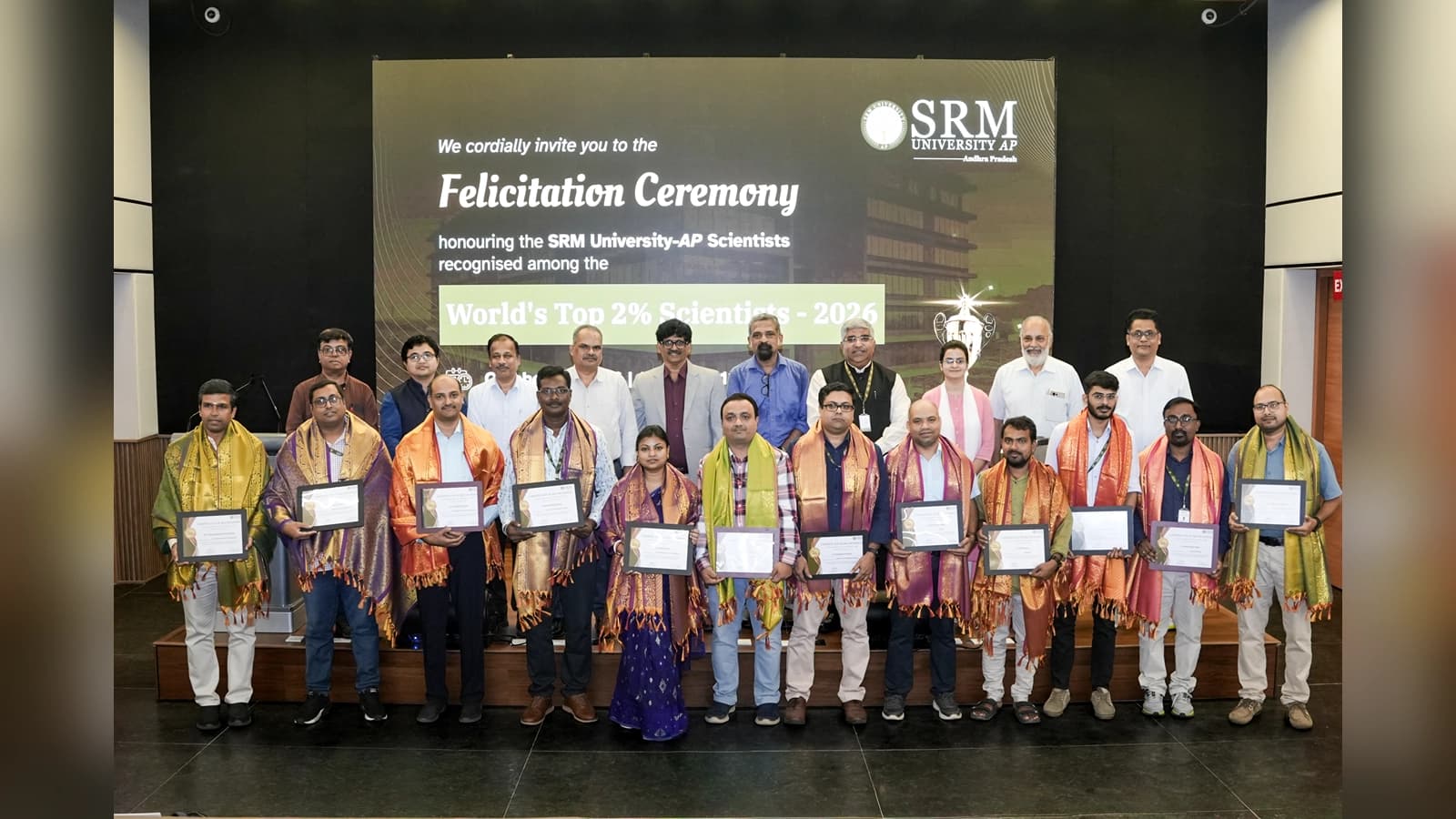
SRM University–AP has reported a significant increase in international research recognition, with 20 faculty members featured in the World’s Top 2% Scientists list. The university’s representation has risen from seven researchers in the previous year, highlighting the breadth of its academic research across multiple scientific disciplines.
According to the university’s official announcement published on October 13, 2026, the recognition reflects the research contributions of its faculty in areas including environmental sciences, information and communication technologies, strategic technologies, physics, chemistry, and mathematics.

The 20 recognised researchers represent six broad academic categories:
Earth and Environmental Sciences: Prof. Rangabhashiyam Selvasembian, Dr Akash Balakrishnan, Dr Deblina Dutta and Prof. Meththika Suharshini Vithanage.
Information and Communication Technologies: Dr Aditya Kumar Sahu, Dr Randhir Kumar, Dr Kshira Sagar Sahoo, Dr Prabhujit Mohapatra and Prof. Saraju Mohanty.
Enabling and Strategic Technologies: Prof. Karthik Rajendran, Dr Vinodkumar Etacheri, Gunda Mohanakrishna, Prof. Lakshminarayana Polavarapu and Prof. Upadrasta Ramamurty.
Physics and Astronomy: Dr Sumit Kumar Mehta, Dr Basabendu Barman and Prof. Yoshiyuki Kawazoe.
Chemistry: Prof. Corrado Di Natale and Dr Sudip Pan.
Mathematics and Statistics: Dr Pintu Bhunia.
The distribution demonstrates the university’s research activity across both established scientific disciplines and technology-focused fields.
The World’s Top 2% Scientists database is compiled by researchers at Stanford University in collaboration with Elsevier, using citation-related data from the Scopus database. It evaluates researchers’ scientific contributions through bibliometric indicators, providing a way to assess the reach and influence of their published work.
However, inclusion in the database should not be interpreted as a universal ranking of every scientist or as a guarantee of research quality in every respect. Citation metrics are one measure of research impact and need to be considered alongside the originality, relevance and practical value of scientific work.
At a felicitation ceremony on campus, SRM University–AP Vice-Chancellor Prof. Ch Satish Kumar emphasised the importance of research quality and long-term impact rather than focusing solely on numerical indicators. He encouraged the recognised faculty members to continue pursuing focused research programmes and contributing to knowledge creation.
Prof. Soumitra Datta, Advisor to the SRM Group, highlighted the role of knowledge creation in building a strong university. Meanwhile, the university’s research and quality-assurance leadership pointed to the importance of international collaboration, academic integrity and research with wider societal relevance.
Prof. Ranjit Thapa, Dean of Research, also noted the increase in the number of recognised faculty members from seven to 20 compared with the previous year.
The latest recognition adds to SRM University–AP’s efforts to strengthen its research profile and interdisciplinary academic work. Its recognised faculty members contribute to fields with applications ranging from environmental sustainability and scientific discovery to digital technologies and advanced engineering.
The increase in representation is a positive indicator of the institution’s growing visibility in research. Sustaining this progress will depend on continued investment in research infrastructure, collaboration, high-quality publications and work that delivers meaningful scientific and societal outcomes.
Ravi River’s Surface-Water Area Shrinks Fivefold After Reservoir Operations, IIT Gandhinagar Study Finds

AI can support learning, but the thinking, curiosity and final effort must belong to the student
SRM University-AP: 20 Faculty Members Named Among World’s Top 2% Scientists

NMC clarifies digital authentication of medical records: Key rules on liability, security and foreign experts
NMC patient safety directive explained: Medical colleges must appoint nodal officers, form committees
NMC clarifies digital authentication of medical records: Key rules on liability, security and foreign experts

‘Dear Italy, how much do you cost us?’ Students pitch tents over soaring rents
Australia passes bill to expand university access and support disadvantaged students
HBKU’s PlasmaPure advances to semifinals in global water desalination competition
Karnataka student elections return after 37 years: Why political restrictions and university polls remain contentious

Ravi River’s Surface-Water Area Shrinks Fivefold After Reservoir Operations, IIT Gandhinagar Study Finds
AI can support learning, but the thinking, curiosity and final effort must belong to the student
SRM University-AP: 20 Faculty Members Named Among World’s Top 2% Scientists
NMC clarifies digital authentication of medical records: Key rules on liability, security and foreign experts
NMC patient safety directive explained: Medical colleges must appoint nodal officers, form committees
NMC clarifies digital authentication of medical records: Key rules on liability, security and foreign experts
‘Dear Italy, how much do you cost us?’ Students pitch tents over soaring rents
Australia passes bill to expand university access and support disadvantaged students
HBKU’s PlasmaPure advances to semifinals in global water desalination competition
Karnataka student elections return after 37 years: Why political restrictions and university polls remain contentious
Copyright© educationpost.in 2026 All Rights Reserved.