


Experts say visible emergency phones and safety apps offer limited protection against sexual assault, as most victims know their attackers and abuse often occurs in private settings.
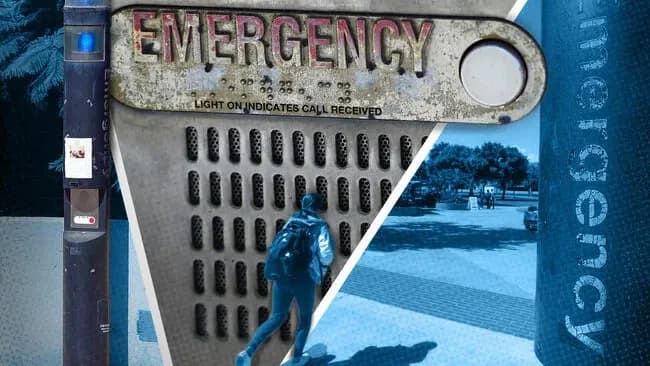
The removal of blue-light emergency phones from university campuses in the United States is reigniting concerns among parents and students about campus safety, even as experts question whether the decades-old technology effectively addresses the risk of sexual assault.
The University of Connecticut (UConn) became the latest institution to decommission most of its blue-light emergency phones last month, citing low usage, rising maintenance costs and the widespread availability of mobile phones. The decision has unsettled some families who view the prominent blue-lit posts as visible symbols of protection, particularly for students walking across campus at night.

Billyjoe Contreras, who toured colleges with his daughter two years ago, said the emergency-phone network helped them feel secure at UConn. Tour guides highlighted how students could see one blue light from the next, creating a sense of reassurance across the campus.
“The poles are the walls protecting our campus,” Contreras told Inside Higher Ed, expressing concern that removing them could leave students feeling more vulnerable.
UConn said its emergency phones had been activated 166 times over the past five years, with all but two calls attributed to tests or pranks. Maintaining the system costs about $70,000 annually, while upgrades are estimated to require another $6 million.
Stephanie Reitz, a university spokesperson, said the widespread adoption of mobile phones and the limited use of the ageing emergency-phone network had made the system obsolete for its original purpose. Continuing to maintain a largely dormant programme, she said, was no longer a practical use of university resources.
The explanation has done little to ease Contreras's concerns, particularly after a widely reported sexual assault allegation at Cornell University, which reportedly involved a fraternity house.
Although UConn plans to retain blue-light phones in areas with poor mobile reception, Contreras questioned whether students in an emergency would always have immediate access to a working, charged phone.
He has filed a legal complaint seeking to prevent the university from removing the lights, warning that campus safety should not depend entirely on personal devices.
Parents and students question the decision
Opposition to the move has extended beyond individual families. More than 4,000 parents, students and other supporters had signed an online petition calling for UConn to retain its blue-light emergency phones as of Friday.
Supporters argue that even infrequent use does not mean the phones have no value. Some believe their visible presence may deter potential offenders, while others say removing them risks undermining students' sense of security.
For many families, the blue lights represent more than a means of contacting emergency services. They are a visible reminder that the university has taken steps to protect students.
Experts, however, say this symbolic reassurance helps explain the technology's popularity more than its effectiveness in preventing sexual violence.
Elizabeth Ellcessor, a media studies professor at the University of Virginia who has researched emergency technologies, said blue-light phones gained prominence in the 1980s as universities sought to address poorly lit campus pathways and growing public concern about sexual assault.
The technology appeared to offer a single solution to both problems by providing visible safety infrastructure and a direct way to seek help.
However, Ellcessor said the system reflects an outdated understanding of sexual assault, which is often wrongly associated with attacks by unknown strangers in isolated places.
Why blue lights may miss the real threat
High-profile crimes in the 1970s and 1980s helped shape public perceptions of campus danger. These included serial killer Ted Bundy's killings at a Florida State University sorority house in 1978 and the 1986 rape and murder of Lehigh University student Jeanne Clery, who was attacked in her dorm room by another student she had never met.
Clery's death helped spur the passage of the Clery Act in 1990, which requires colleges and universities to disclose campus crime statistics and provide information about their safety policies and procedures.
Such cases heightened fears of attacks by strangers, reinforcing the appeal of highly visible emergency systems. Yet experts say that perception does not reflect the circumstances of most sexual assaults.
Research indicates that most victims know their attackers, with estimates suggesting that 85% to 90% of campus sexual assault victims are assaulted by someone they know. Many incidents occur in dormitories, fraternity houses or off-campus accommodation, away from outdoor emergency-phone stations.
Ellcessor said blue-light phones may help people seek assistance in certain situations, but they are poorly positioned to address the settings and relationships in which sexual violence commonly occurs.
She also acknowledged the challenge universities face when replacing a visible safety feature with less noticeable alternatives. Mobile applications may provide more convenient ways to contact emergency services, but they lack the physical presence that reassures students and parents that safety is a priority.
Safety apps cannot address every situation
Universities, including UConn, have increasingly turned to mobile safety applications such as LiveSafe, Rave Guardian and Campus Shield as alternatives to traditional emergency phones. These tools can connect users with emergency services or alert trusted contacts.
However, Amy Hasinoff, a communication professor at the University of Colorado Denver who studies technology and sexual violence, said such applications have significant limitations when it comes to preventing sexual assault.
A person experiencing coercion, intoxication or an abuse of power may not recognise the situation as an emergency or feel able to seek help immediately. In such circumstances, pressing an emergency button or contacting the police may not be a realistic response.
Hasinoff argued that universities need to move beyond approaches that place the responsibility for preventing sexual violence on potential victims and their ability to respond in a crisis.
Instead, she said, prevention efforts should address the behaviour of people who may commit sexual violence and challenge the circumstances that enable abuse.
The debate over UConn's blue-light phones therefore highlights a wider challenge for universities: balancing the reassurance offered by visible safety measures with approaches that address the actual patterns of campus sexual violence.
While emergency phones and safety apps can serve useful purposes in particular circumstances, experts say neither should be mistaken for a comprehensive solution. Meaningful progress requires institutions to focus not only on how victims can summon help, but also on preventing sexual violence before it occurs.

SRM Univ AP expands research footprint with 20 faculty members named to World’s Top 2% Scientists list
SSC GD Constable Result 2026 Declared at ssc.gov.in; Check Roll Numbers in Merit List PDF

Scottish universities warned over espionage risks linked to Chinese research institute

DTU Student Kush Garg Wins IET India Scholarship for AI Device Supporting Neurodivergent Children

Utkal University tightens security after late-night explosions ahead of student polls
Utkal University tightens security after late-night explosions ahead of student polls

IET India Scholarship Award 2026: DTU’s Kush Garg wins top honor for AI device for neurodivergent children

Erasmus Days 2026 celebrates international learning and skills for the future
US universities phase out blue-light emergency phones, raising campus safety concerns

HPU power tussle: Himachal High Court stays Chancellor’s order assigning VC duties to other officials

SRM Univ AP expands research footprint with 20 faculty members named to World’s Top 2% Scientists list
SSC GD Constable Result 2026 Declared at ssc.gov.in; Check Roll Numbers in Merit List PDF
Scottish universities warned over espionage risks linked to Chinese research institute
DTU Student Kush Garg Wins IET India Scholarship for AI Device Supporting Neurodivergent Children
Utkal University tightens security after late-night explosions ahead of student polls
Utkal University tightens security after late-night explosions ahead of student polls
IET India Scholarship Award 2026: DTU’s Kush Garg wins top honor for AI device for neurodivergent children
Erasmus Days 2026 celebrates international learning and skills for the future
US universities phase out blue-light emergency phones, raising campus safety concerns
HPU power tussle: Himachal High Court stays Chancellor’s order assigning VC duties to other officials
Copyright© educationpost.in 2026 All Rights Reserved.