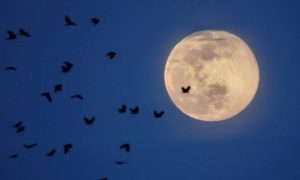
Super Flower Moon: Here’s how to catch the last supermoon of 2020
This week – days before and after the night of the full moon – is best to spot craters on the moon’s surface.
EPN Desk05 May 2020 05:07
Missed the Super Pink Moon last month? Worry not, there is still a chance to witness the last supermoon of 2020.
On May 7, the Super Flower Moon will be visible. It is named so because it comes at a time when the spring is in full bloom. It is also known as the Full Corn Planting Moon and the Full Milk Moon.
The phenomenon of the supermoon takes place when the full moon coincides with the perigee – the closest point to Earth on the elliptical orbit – and thus, appears to be larger than usual.
The year 2020 has already witnessed two supermoons – the Worm Moon in March and the Pink Moon in April.
Flower Moon will be the last supermoon of the year; but it won’t appear as big as the other two because of relatively greater distance.
The next supermoon will be eligible only in April 2021.
According to NASA, the Super Flower Moon will appear to be the biggest and will have attained peak illumination at 04:15 pm on May 7. At this time, the moon will be at a distance of 361,184 kilometres from Earth.
The best time to witness the phenomenon will be during moonrise and moonset.
This week – days before and after the night of the full moon – is best to spot craters on the moon’s surface. It can be done with a set of binoculars or a telescope with basic magnification. Craters like the Copernicus, Tycho, and also the landing site of Apollo 11, in the Sea of Tranquility.
Flower Moon will be the last supermoon of the year; but it won’t appear as big as the other two because of relatively greater distance.
The next supermoon will be eligible only in April 2021.
According to NASA, the Super Flower Moon will appear to be the biggest and will have attained peak illumination at 04:15 pm on May 7. At this time, the moon will be at a distance of 361,184 kilometres from Earth.
The best time to witness the phenomenon will be during moonrise and moonset.
This week – days before and after the night of the full moon – is best to spot craters on the moon’s surface. It can be done with a set of binoculars or a telescope with basic magnification. Craters like the Copernicus, Tycho, and also the landing site of Apollo 11, in the Sea of Tranquility.