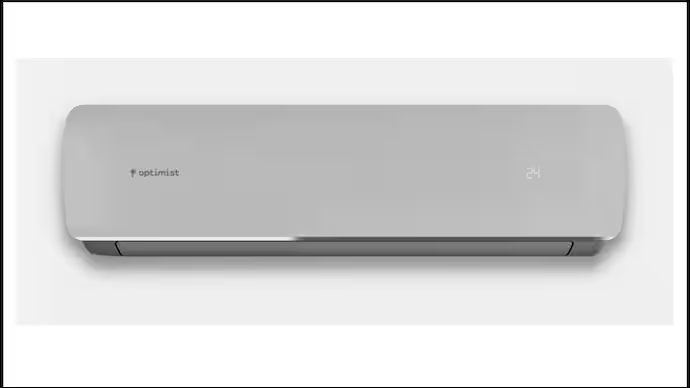
As India grapples with intensifying heatwaves and rising temperatures, a homegrown climate-tech startup is stepping forward with a solution designed for the country’s harsh realities. Optimist, in collaboration with the Indian Institute of Technology Delhi, has developed a next-generation air conditioning system capable of operating efficiently even in extreme ambient temperatures of up to 50°C.
The system, the result of nearly 18 months of joint research and engineering, has successfully completed its pilot phase. Tests show it can maintain effective cooling well beyond controlled lab conditions—delivering consistent performance even under simulated extreme heat environments.

The timing could not be more critical.
Delhi is currently in the grip of an intense and prolonged heatwave. Temperatures across large parts of Delhi-NCR have been hovering between 43°C and 45°C, with the mercury breaching the 40°C mark as early as April 21–22—weeks ahead of what was once considered peak summer. By April 23, the India Meteorological Department issued a yellow alert across the region, noting temperatures running nearly 6°C above normal for late April. As of April 27, the capital has endured four consecutive days of heatwave conditions, with temperatures nearing 45°C.
Against this backdrop, the Optimist-IIT Delhi collaboration is being seen as both timely and necessary.
Professor Anurag Goyal from the Department of Mechanical Engineering served as a technical advisor on the project, with several students from his research group contributing to product development. The partnership brought together academic expertise and industry application to tackle one of India’s most pressing climate challenges.
Pranav Chopra, co-founder and CTO of Optimist, underscored the complexity of designing cooling solutions for India. He pointed to a unique combination of extreme temperatures, high population density, and relatively low per capita income as factors that make conventional systems inadequate.
“The combination of India’s severe heat—up to 50°C—along with economic and demographic constraints creates a uniquely difficult engineering problem,” Chopra said. “The technical expertise and contextual understanding brought in by IIT Delhi have been critical to our R&D efforts. We see this partnership continuing for at least the next decade.”
The collaboration involved extensive engineering work, including the development of HVAC simulation tools, digital twin systems, advanced heat exchanger designs, and rigorous validation under extreme environmental conditions.
To test the system, the company recreated high-temperature scenarios within controlled environments at its facility. The air conditioners were subjected to simulated heat conditions of up to 50°C—and consistently delivered the expected cooling performance while maintaining high energy efficiency.
Professor Goyal noted that India’s climate demands solutions tailored specifically to its extremes. The joint effort, he said, combined detailed simulations with thermal analysis to create a system engineered for real-world Indian conditions.
“This collaboration demonstrates how industry and academia can come together to solve some of the most challenging engineering problems,” he said.
Founded in 2024 by Ashish Goel and Pranav Chopra, Optimist recently raised $12 million to scale manufacturing, strengthen research capabilities, expand its service network, and accelerate the development of its aluminium-enabled cooling platform.
With pilot testing now complete, the startup is preparing to bring its product to market in the coming weeks—offering what could be a much-needed technological response to a rapidly warming India.