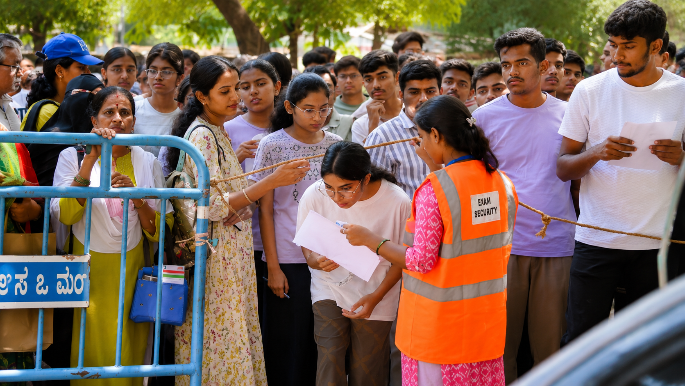
The debate over the National Eligibility-cum-Entrance Test (NEET) has gained fresh momentum after a Tamil Nadu-based education rights organization urged the Centre's High-Powered Task Force (HPTF) on examinations to abolish the National Testing Agency (NTA) and all centralized undergraduate entrance tests.
The State Platform for Common School System-Tamil Nadu (SPCSS-TN), in a memorandum submitted to the HPTF, called for undergraduate admissions to be based on students' board examination marks. It also proposed adopting Tamil Nadu's normalization process for filling All India Quota (AIQ) seats.

The organization questioned whether a central agency should be responsible for controlling evaluation and admission, raising concerns about centralization, access and the role of states in the examination process. These are submissions made by SPCSS-TN to the HPTF and have not been presented as recommendations already accepted by the Centre.
The latest demands are part of a much longer dispute over the common medical entrance examination. Opposition to NEET predates the establishment of the NTA and can be traced back to the process through which a national medical eligibility test was first proposed.
How the NEET system evolved
One of the earliest references to a national eligibility test came from the Medical Council of India (MCI), now replaced by the National Medical Commission (NMC), in December 2010. The proposed system introduced a national entrance examination as an eligibility requirement for admission to undergraduate medical courses. NMC records subsequently listed another notification in 2012.
At the time, India did not have a single common medical entrance examination. The All India Pre-Medical Test (AIPMT), conducted by the Central Board of Secondary Education (CBSE), served as the national-level examination, while states continued to conduct their own entrance examinations.
The proposal for NEET sought to bring medical admissions under one common examination. One of the stated objectives of the proposed system was to reduce the academic pressure on students by replacing multiple entrance examinations with a common test.
CBSE conducted the first NEET in 2013. However, the examination did not immediately become the permanent admission route. The Supreme Court set aside the NEET framework in 2013. Following subsequent legal developments, the common examination process was revived in 2016.
The AIPMT conducted that year effectively became the first phase of NEET, followed by a second examination. From 2017, NEET became the common entrance route for undergraduate medical admissions.
The NTA was established later, in 2018, and took over the conduct of NEET-UG from 2019. This chronology means opposition to the common medical entrance examination existed before the agency that currently conducts the test was established.
What was the medical entrance system before NEET?
Before NEET became the unified medical entrance examination, India's medical admission system involved multiple examinations conducted by different authorities.
CBSE conducted AIPMT before NEET was introduced. AIPMT was used for admissions to 15% of medical seats under the All India Quota, while states conducted separate State Pre-Medical Tests for the remaining seats based on their respective admission systems and school curricula.
Major central institutions also had their own entrance examinations. The All India Institute of Medical Sciences (AIIMS) and the Jawaharlal Institute of Postgraduate Medical Education & Research (JIPMER) operated separate admission tests with their own examination patterns.
As a result, medical aspirants could face several application processes, examinations and travel requirements during a single admission season.
The system was gradually consolidated between 2016 and 2020, with state-level examinations being replaced by the common NEET system and the NTA taking charge in 2019. In 2020, AIIMS and JIPMER also discontinued their separate entrance examinations and joined the unified NEET-based admission system.
How did the exam pattern change?
The examination format also changed as the system moved from multiple tests to a single national examination.
During the earlier AIPMT period, the examination structure changed over time. At one stage, candidates were required to appear for separate preliminary and main examinations, while institutional tests such as the AIIMS entrance examination had distinct formats.
The AIIMS examination, for example, included elements such as General Knowledge and logical reasoning in addition to the science subjects, requiring candidates to prepare beyond the conventional medical entrance syllabus.
Under the NTA, the examination system was standardized around a single-stage objective test. The supplied material describes the NEET format as consisting of 200 multiple-choice questions, of which candidates answer 180, including 45 questions each in Physics and Chemistry and 90 in Biology.
This standardized structure applies to candidates across the country, regardless of whether they are seeking admission to a local government medical college or an institution such as AIIMS.
Why have states opposed NEET?
The objections raised by states have focused on several issues, including differences between school boards, access to coaching, rural and disadvantaged students, language, state control over education and existing admission systems.
Tamil Nadu has been the most sustained opponent of NEET. Before the common examination was introduced, the state used Class 12 marks for professional-course admissions.
State leaders have argued that a national entrance examination could place students following the state board curriculum at a disadvantage compared with candidates preparing through national-level syllabi and private coaching systems.
Tamil Nadu has also connected its opposition to its social justice and reservation policies. The state has maintained that NEET disproportionately affects Tamil-medium students, government school students, rural candidates and first-generation learners.
The opposition has not been confined to Tamil Nadu. During the legal and policy disputes surrounding NEET in 2016, Andhra Pradesh, Telangana and Karnataka also raised objections or sought to retain their own examination arrangements. The concerns varied from state control and language to differences in syllabi and existing admission systems.
Tamil Nadu's opposition became particularly visible in 2017, when its Legislative Assembly passed Bills seeking exemption from NEET. The state continued to seek an exemption from the Centre after the national examination became mandatory.
How are medical seats distributed under NEET?
The unified NEET merit list is now used for admissions to MBBS, BDS, AYUSH and veterinary courses, with seats divided between All India and state-level pools.
Under the 15% All India Quota, government medical colleges across the country contribute 15% of their seats to a national pool. Candidates from any state can compete for these seats, and the central government conducts online counseling for the quota.
The supplied material also states that 100% of seats in Central Universities, AIIMS and JIPMER are filled through the All India system.
The remaining 85% of seats in government medical colleges form the State Quota. These seats are generally reserved for students belonging to the respective state, subject to applicable eligibility and domicile requirements, and counseling is conducted by the state government.
Arguments raised by states
Several states have argued that NEET disadvantages students from rural areas, government schools and state boards while benefiting students who have greater access to CBSE-oriented preparation and coaching institutes.
States have also pointed to controversies surrounding the NTA and examination irregularities as factors affecting confidence in the testing system.
Another part of the dispute concerns the division of responsibilities between the Centre and states. States arguing against a centralized examination have maintained that education is a shared responsibility and that state governments should have greater authority over admissions to medical colleges.
The Centre's position, as described in the supplied material, is that a common entrance examination is necessary to maintain uniform standards across the country.
Tamil Nadu's continuing demand to scrap NEET
Tamil Nadu has repeatedly sought an exemption from NEET and has called for medical admissions to be based on Class 12 examination marks.
The state's Legislative Assembly has passed resolutions and Bills seeking changes to the NEET-based admission system. The material states that the Tamil Nadu Admission to Undergraduate Medical Degree Courses Bill was unanimously approved by the Assembly, but the President withheld assent. The state subsequently challenged the decision before the Supreme Court.
The state has argued that NEET has affected students from Tamil-medium schools, government schools, rural areas and first-generation learner backgrounds and has questioned whether a single entrance examination should determine access to medical education rather than performance across 12 years of schooling.
The supplied material also says that the Tamil Nadu Legislative Assembly passed another resolution urging the Union government to scrap NEET, with the DMK, AIADMK, Left parties and PMK supporting the move. The BJP MLA reportedly walked out during the proceedings.
While moving the resolution, Health Minister K G Arunraj said NEET was against social justice, equality and the rights of states. He argued that the examination had affected medical education opportunities for students from rural and socio-economically disadvantaged backgrounds.
Arunraj also raised concerns over the expansion of coaching centers and what he described as exorbitant fees. He said the examination had shifted students' focus away from the school curriculum toward coaching and argued that a single-day examination was determining access to higher education instead of students' 12 years of schooling.
The resolution cited "paper leaks, loss of young lives, forfeiture of students' trust" as concerns associated with NEET. It also called for medical admissions to be conducted on the basis of Class 12 marks.
Tamil Nadu Finance Minister N. Marie Wilson also reiterated the demand while presenting the state's 2026-27 Budget. The state government allocated ₹8,393 crore to the higher education sector for 2026-27.
The government has also previously called for the Union government to discontinue NEET and restore the earlier admission system based on Plus-2 public examination scores.
In the supplied statement, Wilson said: "The Government of Tamil Nadu therefore urges the union Government to immediately cancel the NEET examination system and revert to medical education admissions based on the earlier system of Class XII public examination marks".
Tamil Nadu's current counseling system
Despite changes introduced by the Medical Counselling Committee (MCC) for All India Quota counseling for the 2026-27 academic year, the Tamil Nadu Selection Committee has said that its existing state counseling process for MBBS and BDS admissions will continue.
An attention notice issued on Aug 3, 2026, by the Directorate of Medical Education and Research (DMER), Chennai, stated that the state counseling process would remain unchanged for the current admission cycle. It would continue to follow provisions contained in the Tamil Nadu prospectus and relevant government orders.
The clarification followed changes introduced by the MCC for AIQ counseling. These included "Freeze" and "Float" options, online document verification for candidates choosing the Float option without initial physical reporting, and a digital seat resignation system through the MCC portal.
Karnataka's demand for CET
Karnataka has also sought changes to the NEET-based medical admission system. The state government has urged the Centre to scrap NEET-UG and bring back the Karnataka Common Entrance Test (CET) for medical admissions.
According to the supplied material, the state government has passed Cabinet and Assembly resolutions supporting the proposal. The argument put forward is that a state-level entrance examination would be better suited to local students and provide a different admission framework from a national examination.
West Bengal and other states
West Bengal has also opposed the centralized medical entrance system. Under former Chief Minister Mamata Banerjee, the state Assembly passed a resolution seeking to replace NEET with a state-level entrance examination.
The concerns cited included the functioning of the NTA and the extent of centralization in medical admissions. The state argued that excessive centralization weakens the role of state governments in education.
Andhra Pradesh, Telangana and Jammu & Kashmir were among the states that challenged NEET legally after its introduction, according to the supplied material. Kerala has also raised concerns about the examination and advocated greater flexibility for states in medical admissions.
The latest controversies surrounding alleged paper leaks and examination irregularities have added to these demands, with several states arguing that one national examination may not adequately account for differences among school education systems across the country.
SPCSS-TN calls for abolition of NTA
The latest memorandum from SPCSS-TN takes the debate beyond NEET itself and questions the broader role of centralized testing.
SPCSS-TN General Secretary P B Prince Gajendra Babu said the NTA had been unable to conduct a single examination without receiving complaints. The organization called for undergraduate admissions to be determined by students' respective board examination marks.
It proposed that Tamil Nadu's normalization method for professional-course admissions, which it described as a "time-tested and transparent process," be adopted for All India Quota seats.
The organization also argued that national eligibility criteria for undergraduate admissions appeared to undermine India's federal structure. It questioned the NTA's authority to evaluate students, noting that the agency is a society registered under the Societies Registration Act rather than an academic institution.
The memorandum further stated that a separate testing agency outsourcing aspects of testing could result in commercial control over the admission process.
To underline its concerns about exclusionary examinations, SPCSS-TN referred to remarks made by Dr. B R Ambedkar in 1927.
“Examination is something quite different from education, but in the name of raising the standard of education, they are making the examination so impossible and so severe that the backward communities which have hitherto not had the chance of entering the portals of university are absolutely kept out,” Babu said.
SPCSS-TN further argued that separating education from evaluation could remove accountability from educational institutions. It appealed to the Union and state governments to strengthen government-funded educational institutions and fulfill the constitutional mandate under Article 41, while arguing that education from school to university should be treated as a fundamental right.
Political demands for abolition
The debate has also extended into political demands for scrapping NEET.
The supplied material states that the Tamilaga Vettri Kazhagam (TVK) said in July that its opposition was not limited to irregularities in NEET and that it wanted the examination abolished altogether. The party also called for states to receive full powers over matters related to medical education.
During student protests over NEET in Delhi, TVK described its position on the examination as "uncompromising and firm" and said the national-level entrance test for medical aspirants should be abolished. It also called for education to be shifted from the Concurrent List to the State List of the Constitution.
The party said that if legal or procedural barriers prevented education from being moved to the State List, a Special Concurrent List could be created as an interim arrangement until those issues were resolved. It said such a framework would give states greater authority over education, including medical education.
"This is our vision for both a permanent and an interim solution. Our victorious leader (Chief Minister C Joseph Vijay) has already emphasised this," the party said.
The TVK also criticized what it described as attempts by political opponents to claim ownership of others' work and ideas. Its statement came amid criticism by Leader of the Opposition Udhayanidhi Stalin over the government's handling of rapper 'Therukkural' Arivu, who has taken a strong stand against NEET.
According to the supplied material, Arivu briefly raised anti-NEET slogans outside the Tamil Nadu Secretariat in the Fort St George campus in Chennai before being taken away by police.
The broader examination reform process
The current NEET debate intersects with a separate question concerning the conduct and administration of national examinations.
The Centre has constituted a High-Powered Task Force headed by Nandan Nilekani to examine the conduct, security, design and governance of public examinations, including examinations conducted by the NTA.
The NTA is therefore currently part of a wider examination-reform exercise. The agency has also shifted its office premises from its earlier location in Okhla to the Government of India Press building on Minto Road in central Delhi.
The SPCSS-TN memorandum brings the issue of centralization into this broader reform discussion. The eventual recommendations of the HPTF and the Centre's response will determine the scope of changes, including whether the focus remains on examination security and administration or extends to the longer-running question of centralized undergraduate admissions.