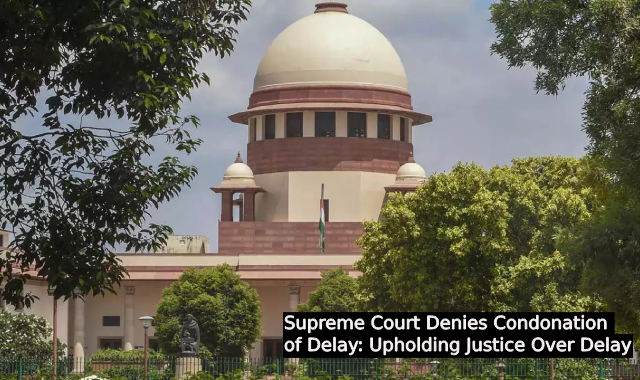
In a recent ruling, the Supreme Court of India displayed a resolute commitment to upholding justice by refusing to condone a significant delay of over 12 years in a restoration suit filed by the Union of India. The apex court's decision underscores the importance of adhering to statutory limitations and preventing undue delays in legal proceedings.
The case in question involved the Union of India seeking condonation of a lengthy delay in filing a restoration suit. Despite the Union's plea, the Supreme Court expressed strong reservations, stating that condoning such a delay would amount to a mockery of justice. Justices Aniruddha Bose and JB Pardiwala, comprising the bench, emphasized that allowing the delay would force the decree-holder to undergo a protracted legal process once again, which would be grossly unfair.

The court's stance was clear: adherence to statutory limitations is crucial to ensure the timely dispensation of justice. Delays in legal proceedings can not only cause undue hardship to litigants but also undermine the integrity of the judicial system. By refusing to condone the delay, the Supreme Court sent a strong message that justice delayed is indeed justice denied.
The judgment highlighted the fundamental principles underlying the rules of limitation, emphasizing that they are based on sound public policy and principles of equity. The court underscored that the purpose of limitation rules is not merely technical but rooted in ensuring fairness and preventing undue prejudice to either party
The case serves as a reminder that the courts should not keep the "Sword of Damocles" hanging over litigants' heads indefinitely. Justice should be swift and equitable, and allowing inordinate delays runs counter to these principles. The Supreme Court's decision reaffirms its commitment to upholding the rule of law and ensuring that justice is served promptly and fairly.
The background of the case sheds light on the complexities involved in legal proceedings and the importance of diligence in pursuing legal remedies. Despite multiple opportunities to address the delay, the Union of India failed to provide sufficient justification for its inaction, leading to the dismissal of its application for restoration.
In conclusion, the Supreme Court's decision to deny condonation of delay in the restoration suit reflects its unwavering commitment to justice and fairness. By upholding statutory limitations and preventing undue delays, the court reinforces the principles that underpin the rule of law. In doing so, it ensures that the integrity of the judicial system remains intact and that justice is served without undue delay.






.jfif&w=256&q=75)





.webp&w=256&q=75)
