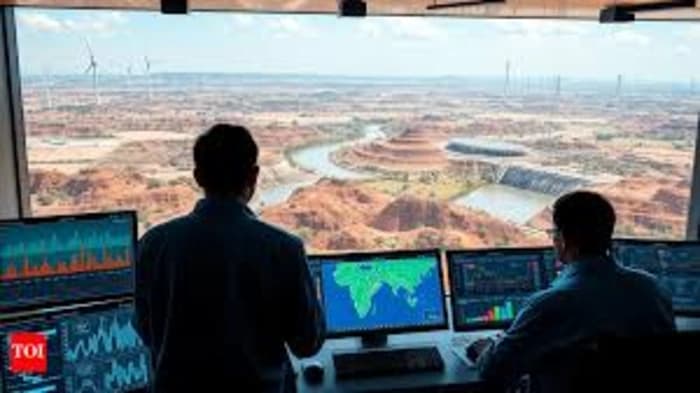
The Ministry of Power has initiated a task force to develop the India Energy Stack (IES) — a Digital Public Infrastructure designed to revolutionize India’s power sector via secure and interoperable digital systems

Concerning the India Energy Stack (IES):
The India Energy Stack (IES) is an extensive digital public infrastructure (DPI) for the energy sector, aimed at facilitating smooth, secure, and instantaneous coordination among generation, distribution, and consumption.

Created By: The program is led by the Ministry of Power, Government of India.
Aim:
Revamp the energy industry with a cohesive digital infrastructure.
Facilitate secure data exchange and instantaneous analytics.
Enhance services focused on consumers and improve grid effectiveness.
Assist India in achieving its Net Zero targets and economic objectives.
Main Characteristics of IES:
Distinct Identifiers: For consumers, energy resources, and energy-associated transactions to guarantee accuracy and traceability.
Immediate, Consent-Driven Data Exchange: Data sharing among stakeholders (consumers, utilities, policymakers) will be safe, authorized, and instantaneous.
Open APIs for Interoperability: Facilitates smooth integration with external systems, emerging companies, and service vendors.
Utility Intelligence Platform (UIP): A flexible application developed on IES that offers analytics, insights, and decision-making assistance for DISCOMs, policymakers, and users.
Tools for Consumer Empowerment: Functions that facilitate selection, comparison, and engagement in energy markets.
Anticipated Results:
White Paper on IES to be published for public input and policy development.
Trial initiatives in Delhi, Gujarat, and Mumbai to evaluate the IES through practical implementations.
A national implementation plan for IES derived from feedback, effectiveness, and scalability.
Improved grid durability, integration of renewables, and DISCOM effectiveness.
Modernizing power infrastructure digitally to align with the success of Aadhaar and UPI.

Patriarchal Bargain: How Women Are Challenging Restrictions in the Name of Safety
El Niño 2026: India Faces Growing Risks of Drought, Food Inflation and Water Stress

Rig Veda’s Female Voices: Can They Be Considered Women Poets?

Navi Pillay Wins 2026 Nobel Peace Prize for Advancing Human Rights and International Justice

IISc’s TANUH Uses Artificial Intelligence to Strengthen Healthcare in India
.jpg&w=256&q=75)
University of Arizona suspends fraternity activities as misconduct reports mount
.jpg&w=256&q=75)
Cornell rape accuser was misled about criminal probe, lawyer alleges
.webp&w=256&q=75)
Over 1,000 US colleges fail to submit student outcomes data by deadline

Inside the 382nd Report: Every Recommendation Parliament's Panel Made on NTA After the NEET Leak
.jpg&w=256&q=75)
IIM Ahmedabad, IESE and HEC Montréal chiefs join global EQUIS Accreditation Board

Patriarchal Bargain: How Women Are Challenging Restrictions in the Name of Safety
El Niño 2026: India Faces Growing Risks of Drought, Food Inflation and Water Stress

Rig Veda’s Female Voices: Can They Be Considered Women Poets?

Navi Pillay Wins 2026 Nobel Peace Prize for Advancing Human Rights and International Justice

IISc’s TANUH Uses Artificial Intelligence to Strengthen Healthcare in India
.jpg&w=256&q=75)
University of Arizona suspends fraternity activities as misconduct reports mount
.jpg&w=256&q=75)
Cornell rape accuser was misled about criminal probe, lawyer alleges
.webp&w=256&q=75)
Over 1,000 US colleges fail to submit student outcomes data by deadline

Inside the 382nd Report: Every Recommendation Parliament's Panel Made on NTA After the NEET Leak
.jpg&w=256&q=75)
IIM Ahmedabad, IESE and HEC Montréal chiefs join global EQUIS Accreditation Board
Copyright© educationpost.in 2024 All Rights Reserved.
Designed and Developed by @Pyndertech