The Axiom-4 (Ax-4) expedition
It will remain on the ISS for 14 to 21 days, carrying out more than 60 experiments in partnership with 31 nations, focusing on areas such as biomedical research, Earth observation, and materials science.

Certain experiments include ISRO, providing India crucial knowledge for the forthcoming Gaganyaan mission, now anticipated in 2027.
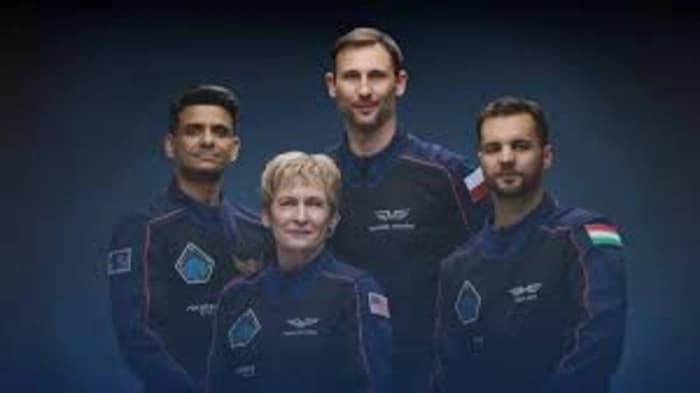
The Ax-4 team consists of individuals from India, Poland, and Hungary, representing each country's inaugural voyage to the space station and the second government-backed human spaceflight in more than four decades.
Shubhanshu Shukla will be the second Indian astronaut to travel to space since 1984.
The mission underscores Axiom Space’s contribution to enhancing global accessibility to low-Earth orbit.
The International Space Station (ISS)
– Its design occurred from 1984 to 1993, with the assembly of its parts starting in the late 1980s throughout the US, Canada, Japan, and Europe.
– The ISS initiative brings together international flight teams, different launch systems, global operations and training centers, communication networks, and the international scientific research community.
Axiom’s Path to the ISS
To arrive at the ISS, the mission must launch during a precisely timed window that matches the spacecraft’s path with the orbit of the ISS.
Once launched, the first stage of Falcon 9 detaches and descends back to Earth, while the second stage proceeds with the climb before deploying the Dragon capsule into orbit.
The ISS, positioned approximately 400 km above the Earth and traveling at 28,000 km/h, necessitates the Dragon to incrementally elevate its orbit and modify its trajectory using 16 Draco thrusters through a sequence of phasing maneuvers.
In contrast to Russia’s quicker Soyuz spacecraft, Dragon generally requires around 28 hours to arrive at the ISS because of its advanced design and the necessity to perform in-flight evaluations.
Approaching the station, Dragon executes one last maneuver, enters the 200-meter “keep-out sphere,” and employs GPS, cameras, and Lidar for self-guided docking.



.jfif&w=256&q=75)
.jpg&w=256&q=75)
.jpg&w=256&q=75)
.webp&w=256&q=75)
.jpg&w=256&q=75)