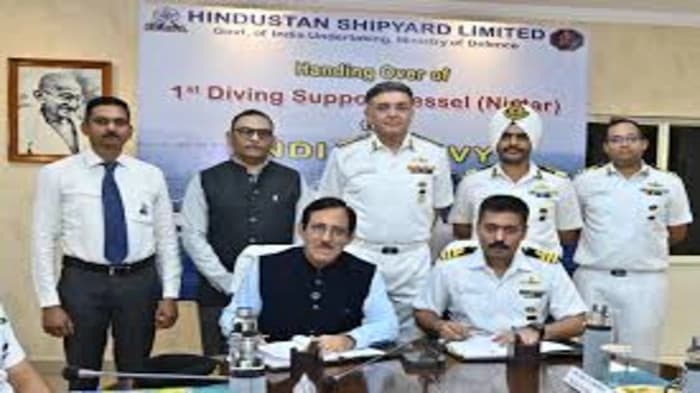
The Indian Navy will launch INS Nistar, its first locally designed Diving Support Vessel (DSV), at Visakhapatnam. This signifies an important achievement in India's voyage towards underwater rescue and maritime independence

What does INS Nistar refer to?
INS Nistar is India’s inaugural domestically produced Diving Support Vessel (DSV) intended for deep-sea diving, submarine rescue, and underwater missions.

It acts as the main ship for the Deep Submergence Rescue Vehicle (DSRV).
Created by:
Hindustan Shipyard Limited (HSL), located in Visakhapatnam
Constructed under the Ministry of Defence with 80% local content, engaging more than 120 MSMEs.
Goals of INS Nistar:
Assist in submarine rescue missions and urgent evacuations.
Execute saturation diving and air diving operations in deep seas.
Improve India's capabilities for underwater operations and maritime readiness.
Minimize reliance on international assistance during underwater emergency situations.
Main Characteristics:
Imposing and Strong Frame:
Displacement: More than 10,000 tons
Length: 120 meters
Stamina: Over 60 days on the ocean
Advanced Positioning & Navigation: Fitted with a Dynamic Positioning System for accuracy in intricate underwater operations.
Diving and Emergency Response Skills:
Contains saturation diving systems, air diving chambers, ROVs, and Side Scan SONAR.
Serves as the main vessel for DSRVs, extending submarine rescue capabilities.
Medical Infrastructure: Comprises operating theater, ICU, 8-bed facility, and hyperbaric chambers for diver rehabilitation and care.
Multi-Mission Assistance: Includes a helicopter landing area and a 15-ton subsea crane for logistics and recovery tasks.
Importance:
Bolsters India's Atmanirbhar Bharat program in naval ship construction.
Boosts India’s strategic preparedness in the Indian Ocean Region (IOR).
Addresses an essential capability shortfall in submarine rescue and maritime emergency response.
Symbolically resurrects the heritage of the former Soviet-origin INS Nistar (1971).

Patriarchal Bargain: How Women Are Challenging Restrictions in the Name of Safety
El Niño 2026: India Faces Growing Risks of Drought, Food Inflation and Water Stress

Rig Veda’s Female Voices: Can They Be Considered Women Poets?

Navi Pillay Wins 2026 Nobel Peace Prize for Advancing Human Rights and International Justice

IISc’s TANUH Uses Artificial Intelligence to Strengthen Healthcare in India
.jpg&w=256&q=75)
University of Arizona suspends fraternity activities as misconduct reports mount
.jpg&w=256&q=75)
Cornell rape accuser was misled about criminal probe, lawyer alleges
.webp&w=256&q=75)
Over 1,000 US colleges fail to submit student outcomes data by deadline

Inside the 382nd Report: Every Recommendation Parliament's Panel Made on NTA After the NEET Leak
.jpg&w=256&q=75)
IIM Ahmedabad, IESE and HEC Montréal chiefs join global EQUIS Accreditation Board

Patriarchal Bargain: How Women Are Challenging Restrictions in the Name of Safety
El Niño 2026: India Faces Growing Risks of Drought, Food Inflation and Water Stress

Rig Veda’s Female Voices: Can They Be Considered Women Poets?

Navi Pillay Wins 2026 Nobel Peace Prize for Advancing Human Rights and International Justice

IISc’s TANUH Uses Artificial Intelligence to Strengthen Healthcare in India
.jpg&w=256&q=75)
University of Arizona suspends fraternity activities as misconduct reports mount
.jpg&w=256&q=75)
Cornell rape accuser was misled about criminal probe, lawyer alleges
.webp&w=256&q=75)
Over 1,000 US colleges fail to submit student outcomes data by deadline

Inside the 382nd Report: Every Recommendation Parliament's Panel Made on NTA After the NEET Leak
.jpg&w=256&q=75)
IIM Ahmedabad, IESE and HEC Montréal chiefs join global EQUIS Accreditation Board
Copyright© educationpost.in 2024 All Rights Reserved.
Designed and Developed by @Pyndertech