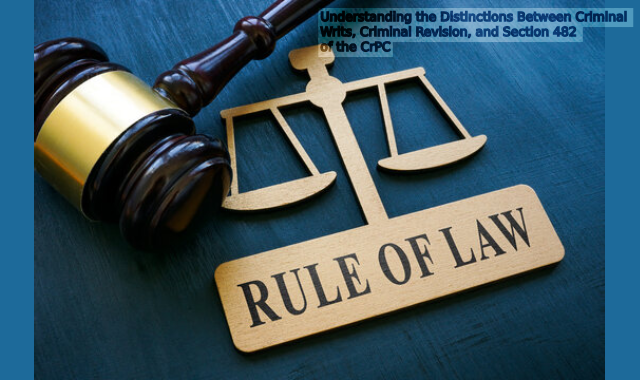
In the labyrinth of legal proceedings, litigants often find themselves at a crossroads, faced with the daunting task of choosing the most efficacious legal remedy. Section 482 of the CrPC, Article 226 of the Indian Constitution, and Criminal Revision under Section 397 offer distinct avenues for seeking redress and rectifying injustices. This article delves into the nuances of these avenues, elucidating their scope, applicability, and inherent challenges, while offering insights gleaned from pertinent case laws.
Deciphering Criminal Writs: Article 226 of the Indian Constitution empowers High Courts to issue writs for the enforcement of fundamental rights and quashing of criminal proceedings. Criminal writ petitions serve as potent instruments to address violations of fundamental rights or challenge criminal proceedings initiated against an individual. From quashing FIRs to addressing custodial violence, criminal writs encompass a broad spectrum of legal remedies.

Navigating Criminal Revision: Section 397 of the CrPC furnishes the High Court and Sessions Judge with the authority to review judgments or sentences passed by subordinate criminal courts. Criminal Revision serves as a streamlined mechanism for scrutinizing lower court orders, ensuring their legality and fairness. However, its scope is limited to reviewing final judgments or sentences and cannot be invoked to challenge interlocutory orders.
Harnessing the Inherent Powers of Section 482: Section 482 of the CrPC confers inherent powers upon High Courts to secure the ends of justice and prevent abuse of the legal process. This provision offers a flexible recourse for litigants, allowing the court to make orders conducive to the administration of justice. Yet, these powers are circumscribed by certain limitations and must be exercised judiciously to avoid encroaching upon statutory provisions.
Navigating the Legal Landscape: A Litigant's Dilemma: The choice between these legal remedies poses a conundrum for litigants, necessitating a careful evaluation of the circumstances at hand. While criminal writs offer a robust mechanism for addressing violations of fundamental rights, they entail procedural complexities and protracted timelines. Criminal Revision, on the other hand, provides a more expedient review process but is circumscribed by its limited scope. Section 482 of the CrPC, with its inherent powers, presents a middle ground, offering flexibility but subject to the court's discretion.
Building Opportunities Amidst Challenges: In the face of uncertainty, litigants are encouraged to adopt a proactive stance, akin to Milton Berle's adage, "If opportunity doesn't knock, build a door." By leveraging legal expertise and strategic advocacy, litigants can navigate the complexities of the legal landscape, charting a course towards justice. Informed decision-making, supplemented by insights from judicial precedents, empowers litigants to make prudent choices and pursue avenues conducive to their cause.
Conclusion: The plethora of legal remedies available to litigants underscores the resilience of India's judicial framework. However, the efficacy of these remedies hinges upon informed decision-making and strategic advocacy. By understanding the nuances of criminal writs, criminal revision, and section 482 of the CrPC, litigants can navigate the legal labyrinth with confidence, ensuring that justice is not just a distant ideal but a tangible reality.






.jfif&w=256&q=75)



.webp&w=256&q=75)