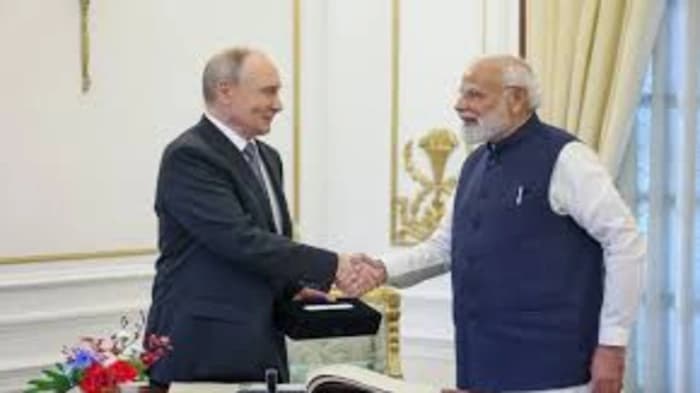
During President Vladimir Putin’s visit to India in early December 2025, India and Russia signed a series of economic and labour cooperation agreements under the India–Russia 2030 Roadmap, signalling a broadening of bilateral ties beyond their traditional defence-centric engagement. The agreements reflect a shared intent to deepen economic integration, enhance people-to-people contact, and build resilience against geopolitical and economic disruptions.
Key Agreements and Outcomes:
A major highlight was the Labour Mobility Agreement, aimed at facilitating the movement of skilled Indian professionals to Russia in sectors such as construction, information technology, healthcare, and engineering. This addresses Russia’s labour shortages while creating overseas employment opportunities for Indian workers. Additionally, Memoranda of Understanding were signed on urea production, supporting India’s fertiliser security and reducing vulnerability to global supply shocks.

The two sides also agreed to strengthen maritime, logistics, and customs cooperation, particularly along strategic corridors such as the Chennai–Vladivostok Maritime Corridor and the International North–South Transport Corridor (INSTC). These initiatives are expected to reduce transportation costs, improve trade efficiency, and enhance connectivity between South Asia, Eurasia, and Europe.
Economic and Strategic Significance:
The agreements mark a diversification of India–Russia cooperation into labour mobility, industrial capacity, and trade facilitation. Expanding economic engagement helps stabilise bilateral relations amid shifting global power dynamics and sanctions-related constraints faced by Russia. For India, access to energy resources, fertilisers, and new markets aligns with its developmental and strategic priorities.
Currency and Financial Cooperation:
The push for rupee–ruble trade settlement mechanisms seeks to reduce dependence on the US dollar, enhance financial autonomy, and ensure continuity of bilateral trade despite external sanctions pressures.
Challenges and Way Forward:
Effective implementation will require regulatory coordination, protection of migrant workers’ rights, and infrastructure upgrades along trade corridors. Ensuring transparency and long-term viability of alternative payment systems is equally critical.
Conclusion:
The agreements reaffirm India–Russia relations as a multifaceted strategic partnership. By expanding cooperation into economic, labour, and connectivity domains, both countries aim to build a resilient and future-oriented bilateral framework.