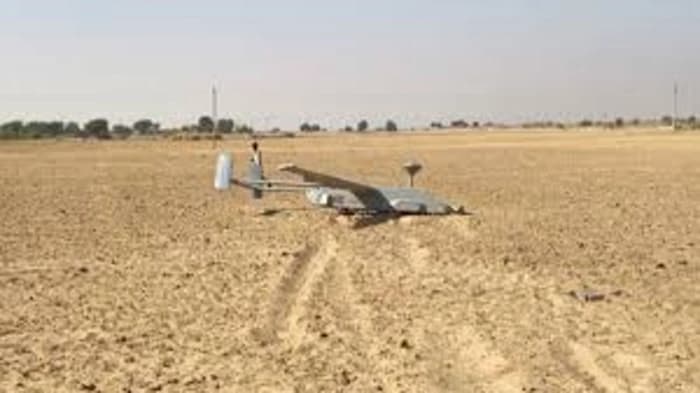
A damaged unmanned aerial vehicle (UAV) belonging to the Indian Air Force (IAF) was discovered in a field near Ramgarh in Rajasthan’s Jaisalmer district, close to the India–Pakistan border. The incident has prompted a joint investigation by the Ramgarh Police and IAF technical teams to determine the circumstances that led to the crash. Eyewitnesses reported that the UAV appeared to have sustained major structural damage, indicating either an abrupt systems failure or an external disruption.
Initial assessments point towards two broad possibilities. One is a technical malfunction, which remains a common challenge in high-end UAV operations, particularly in harsh desert environments where excessive heat, dust storms, and wind turbulence can affect propulsion, sensors, and avionics. The second possibility is foreign interference, such as GPS jamming or electronic disruption, although no evidence has yet confirmed this. Given the UAV’s proximity to the international border, investigators are analysing whether any hostile activity may have compromised navigational or communication systems.

The incident carries strategic significance because UAVs serve as a critical surveillance tool for monitoring infiltration routes, troop movements, and potential cross-border threats. A crash in such a sensitive zone temporarily reduces situational awareness and highlights the vulnerabilities of relying solely on unmanned systems for real-time intelligence.
Moreover, the episode raises broader questions about the robustness of India’s drone ecosystem. It underscores the need for improved electronic shielding, enhanced fail-safe mechanisms, and indigenous technological upgrades to reduce dependence on external components. The crash also reinforces the importance of a multi-layered surveillance strategy that integrates drones with satellite imagery, thermal sensors, and ground-based radars.
As investigations continue, the incident is likely to fuel discussions on strengthening border management through more resilient UAV technologies and better preparedness for electronic and cyber-based threats.