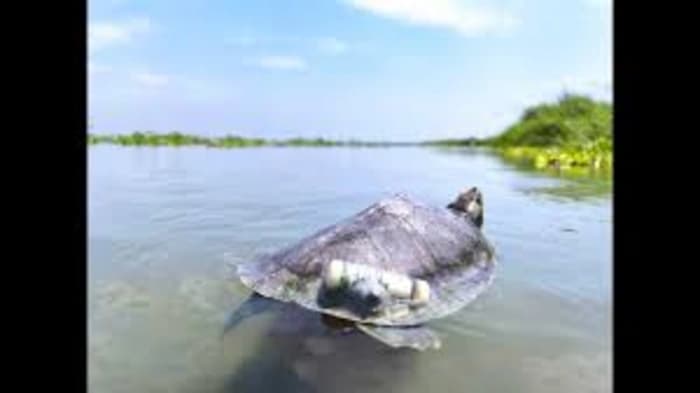
Following a span of 30 years, 20 critically endangered Red-Crowned Roofed Turtles (Batagur kachuga) have been successfully reintroduced into the Ganga River as part of the Namami Gange Mission, representing a significant achievement in biodiversity conservation

Overview of Red-Crowned Roofed Turtles (Batagur kachuga):
Scientific Classification: Batagur kachuga

Geographical Distribution:
Countries: India, Nepal, Bangladesh
Rivers: Ganga, Brahmaputra (historical); Chambal (current viable habitat)
Conservation Status:
IUCN (Global): Critically Endangered
Indian Wildlife Act: Schedule I (Highest Protection)
CITES (International Trade): Appendix I (Banned)
Distinctive Characteristics:
Size: Females can reach lengths of up to 56 cm (approximately 2 feet) and weigh around 25 kg (55 lbs), while males are significantly smaller and lighter.
Shell: Their robust, ridged shell enables them to navigate strong currents, and juvenile turtles possess angled undersides (plastron) for added protection.
Snout: They feature a short, slightly pointed snout that facilitates breathing while remaining submerged.
Coloration: During the breeding season, males exhibit vibrant red, yellow, and blue markings on their necks to attract females.
Behavior and Habitat:
Habitat: They inhabit deep, swiftly flowing rivers and require sandy beaches or sandbars for egg-laying.
Diet: They are strict herbivores, consuming only aquatic vegetation and algae.
Reproductive Period: Mating and nesting occur between March and April, coinciding with warmer temperatures.
Egg Laying: Females excavate nests in the sand, laying between 11 to 30 eggs per clutch, which typically hatch after 60 to 70 days.
Challenges:
Habitat Degradation: Pollution, dam construction, and excessive water extraction threaten their riverine habitats.
Nesting Challenges: Sand mining and agricultural activities along riverbanks compromise nesting sites, leaving eggs vulnerable.
Poaching and Trade: Despite legal protections, they are hunted for their meat (considered a delicacy) and shells (used for decorative purposes).

India’s Blue Economy Push Seeks to Balance Growth and Ocean Conservation

Supreme Court Seeks Panel to Curb Unethical Pharma Marketing Practices

NMC Tightens Rules on Doctors’ Digital Advertising and AI Use

Anthropic Launches Claude Haiku 5.5 as Its Fastest and Cheapest AI Model

Karnataka HC Replaces ‘Visitation’ with ‘Parenting Time’ in Child Custody Cases

Canadian author Anne Carson wins 2026 Nobel Prize in Literature for reshaping contemporary literary forms

AMU students’ protest enters third week as union election demand widens

DPDP Act Explained: What is India’s Digital Personal Data Protection Law and Why is it in the News?

IIT Bombay puts stricter cheating rules on hold, drafts new procedure for exam misconduct

Gujarat launches PARAKH Cell to shift school assessments toward competency-based learning

India’s Blue Economy Push Seeks to Balance Growth and Ocean Conservation

Supreme Court Seeks Panel to Curb Unethical Pharma Marketing Practices

NMC Tightens Rules on Doctors’ Digital Advertising and AI Use

Anthropic Launches Claude Haiku 5.5 as Its Fastest and Cheapest AI Model

Karnataka HC Replaces ‘Visitation’ with ‘Parenting Time’ in Child Custody Cases

Canadian author Anne Carson wins 2026 Nobel Prize in Literature for reshaping contemporary literary forms

AMU students’ protest enters third week as union election demand widens

DPDP Act Explained: What is India’s Digital Personal Data Protection Law and Why is it in the News?

IIT Bombay puts stricter cheating rules on hold, drafts new procedure for exam misconduct

Gujarat launches PARAKH Cell to shift school assessments toward competency-based learning
Copyright© educationpost.in 2024 All Rights Reserved.
Designed and Developed by @Pyndertech