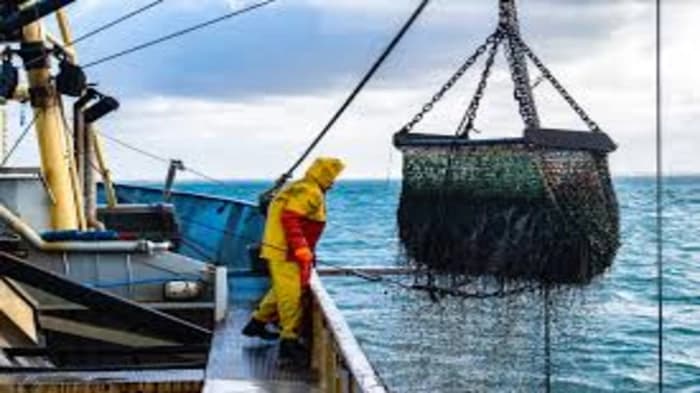
India’s fisheries sector is under pressure from US-imposed curbs and demand for sustainable practices. Adapting to environmental, economic, and trade norms is critical

Trade Tensions and Fisheries
The US has imposed sustainability-linked trade restrictions on seafood, motivating exporters to meet stricter standards.

Indian exporters face non‑tariff barriers, certification demands, and traceability requirements.
Importance of Sustainability in Fisheries
Overfishing, habitat loss (mangroves, coral reefs) and climate change threaten marine stocks.
Small-scale fishers often lack resources to meet certification norms or invest in eco-friendly practices.
Key Policy Measures Under Consideration
Incentivizing sustainable fisheries: subsidies, technical assistance for eco‑friendly gear, certification support.
Institutional mechanisms: fisher cooperatives, certification agencies, traceability systems.
Research and monitoring: stock assessments, marine spatial planning, habitat restoration.
Export linkages: aligning Indian standards with global benchmarks (e.g. MSC, GSSI).
Challenges
Cost burden on small fishers to upgrade practices without losing income.
Enforcement and monitoring in extensive marine zones.
Coordination across states, maritime zones, coastal communities, and export agencies.
Dependence on global markets vulnerable to trade disruptions.
Way Forward
Public-private partnerships to enable sustainable infrastructure (cold chains, processing).
Capacity building for fishers to earn “sustainability premium.”
Integrated coastal zone management to preserve habitats.
Diplomatic engagement to negotiate trade norms rather than just comply.
Conclusion
India’s fisheries sector must transition from volume to value, embedding sustainability to withstand external pressures and enhance resilience.

Heatwave prompts school closures in parts of Bihar and Uttar Pradesh

Ashoka University appoints former IIM Bangalore director Rishikesha Krishnan as VC

CIC directs CBSE to disclose details on board exam expenditure and answer book procurement

KVS mandates at least one Sanskrit section in Classes 6 and 9 under new language framework
.jpg&w=256&q=75)
NTA opens NEET Fee Refund 2026 correction window for bank detail verification

KVS mandates at least one Sanskrit section in Classes 6 and 9 under new language framework
.jpg&w=256&q=75)
NTA opens NEET Fee Refund 2026 correction window for bank detail verification

NTA addresses technical glitches in NEET UG 2026 re-exam admit card download

PM Modi gets grand diaspora welcome in Nice ahead of talks with Macron, G7 summit

NTA launches certification program for invigilators and center superintendents

Heatwave prompts school closures in parts of Bihar and Uttar Pradesh

Ashoka University appoints former IIM Bangalore director Rishikesha Krishnan as VC

CIC directs CBSE to disclose details on board exam expenditure and answer book procurement

KVS mandates at least one Sanskrit section in Classes 6 and 9 under new language framework
.jpg&w=256&q=75)
NTA opens NEET Fee Refund 2026 correction window for bank detail verification

KVS mandates at least one Sanskrit section in Classes 6 and 9 under new language framework
.jpg&w=256&q=75)
NTA opens NEET Fee Refund 2026 correction window for bank detail verification

NTA addresses technical glitches in NEET UG 2026 re-exam admit card download

PM Modi gets grand diaspora welcome in Nice ahead of talks with Macron, G7 summit

NTA launches certification program for invigilators and center superintendents
Copyright© educationpost.in 2024 All Rights Reserved.
Designed and Developed by @Pyndertech