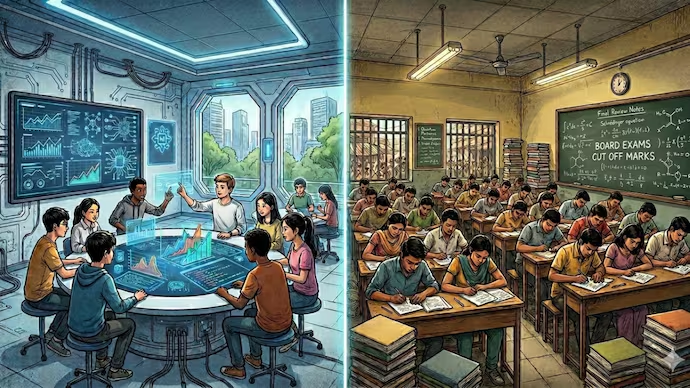
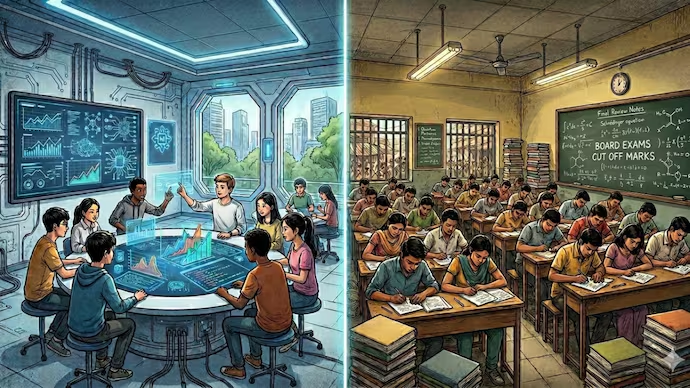
China is quietly redesigning its classrooms for a world shaped by artificial intelligence, automation, and rapidly shifting skills. India, in contrast, continues to measure success largely through marks, ranks, and entrance exams — an approach that is now colliding with the realities of a changing global economy.
The divergence began to sharpen in 2021, when China rolled out its “Double Reduction” policy—curbing excessive homework and cracking down on its massive private tutoring industry. What initially appeared as regulatory tightening soon revealed itself as a deeper reset: a shift away from rote learning toward a system focused on capability-building.

At its core, the reform aimed to ease academic pressure, reduce memorization, and bring learning back into classrooms. Since then, China has steadily pushed application-based education, embedding technology into teaching and aligning learning outcomes with long-term national priorities.
“China is trying to move from a system that selects toppers to one that builds capabilities at scale,” says Rohan Dua, a research fellow at BHU. “The emphasis is increasingly on what students can do, not just what they can recall.”
Indian academia is asking similar questions—but change remains uneven. “Degrees are no longer enough. We have to ask whether our students are being trained to solve problems or simply to pass exams,” notes Sekar Viswanathan, senior faculty at Vellore Institute of Technology.
That concern is now backed by data. The State of Working India 2026 report by Azim Premji University found that nearly 40% of young graduates in India are struggling to find jobs—despite expanding access to higher education. The disconnect between education and employability, long debated, is now intensifying as industries evolve faster than curricula.
Technology is reshaping entry-level roles, demanding adaptability over memorization. Here, China appears to hold an early advantage. Its classrooms are not only teaching technology as a subject but using it as a tool—exposing students to real-world applications from an early stage.
India, meanwhile, has signalled intent. Policy discussions around integrating emerging technologies and promoting multidisciplinary learning are underway. But implementation remains patchy, often limited to well-resourced institutions.
“There is a clear recognition in India that the system needs to change,” says Dr Pankaj Agarwal, former Secretary, Higher Education. “The challenge is translating policy into practice across such a large and diverse system.”
The coaching economy that won’t fade
If China’s system is increasingly shaped by state intervention, India’s continues to be driven by market forces. From Kota to Hyderabad and Delhi, coaching centres remain central to the academic journey—where success is defined by cut-offs, ranks, and exam scores.
For students, this creates a narrow definition of achievement. “Everything still feels like a race. Marks decide our college, our options, even how people judge us,” says a Class 12 student from Noida.
Education policy analyst Vikas Gupta, a former School Education Secretary, believes this model is losing relevance. “India’s system still rewards memory more than adaptability. That may have worked earlier, but it is not enough going forward.”
China, by contrast, has actively dismantled much of its tutoring ecosystem to reduce inequality and pressure. India has yet to take a similar step.
Two visions of success
At a deeper level, the contrast is philosophical. India’s system continues to reward accuracy, speed, and the ability to reproduce knowledge in standardized exams. China is gradually shifting toward problem-solving, application, and alignment with industry needs.
Neither model is without criticism. China’s approach is often seen as tightly controlled, while India’s is criticised for being excessively competitive. But the direction of change is stark: one system is trying to move beyond exams, the other remains defined by them.
China’s reforms are closely tied to sectors it aims to dominate—technology, manufacturing, and advanced research. India risks producing graduates for roles that are rapidly evolving or disappearing, widening the gap between education and employment.
Access remains another fault line. India’s digital divide continues to limit exposure to emerging skills across regions and socio-economic groups.
The question that won’t go away
India is not standing still. Policy frameworks are pushing for flexibility, skill development, and multidisciplinary education. There is growing awareness that the system must evolve.
But the pace of reform is slow—and the world is changing faster.
The comparison is not about choosing one model over another. It is about recognizing where education is headed. China is preparing students for what comes next. India is still testing them on what came before.
And as the nature of work continues to transform, one question becomes unavoidable: are Indian students being prepared for the future—or for a system that is already fading?