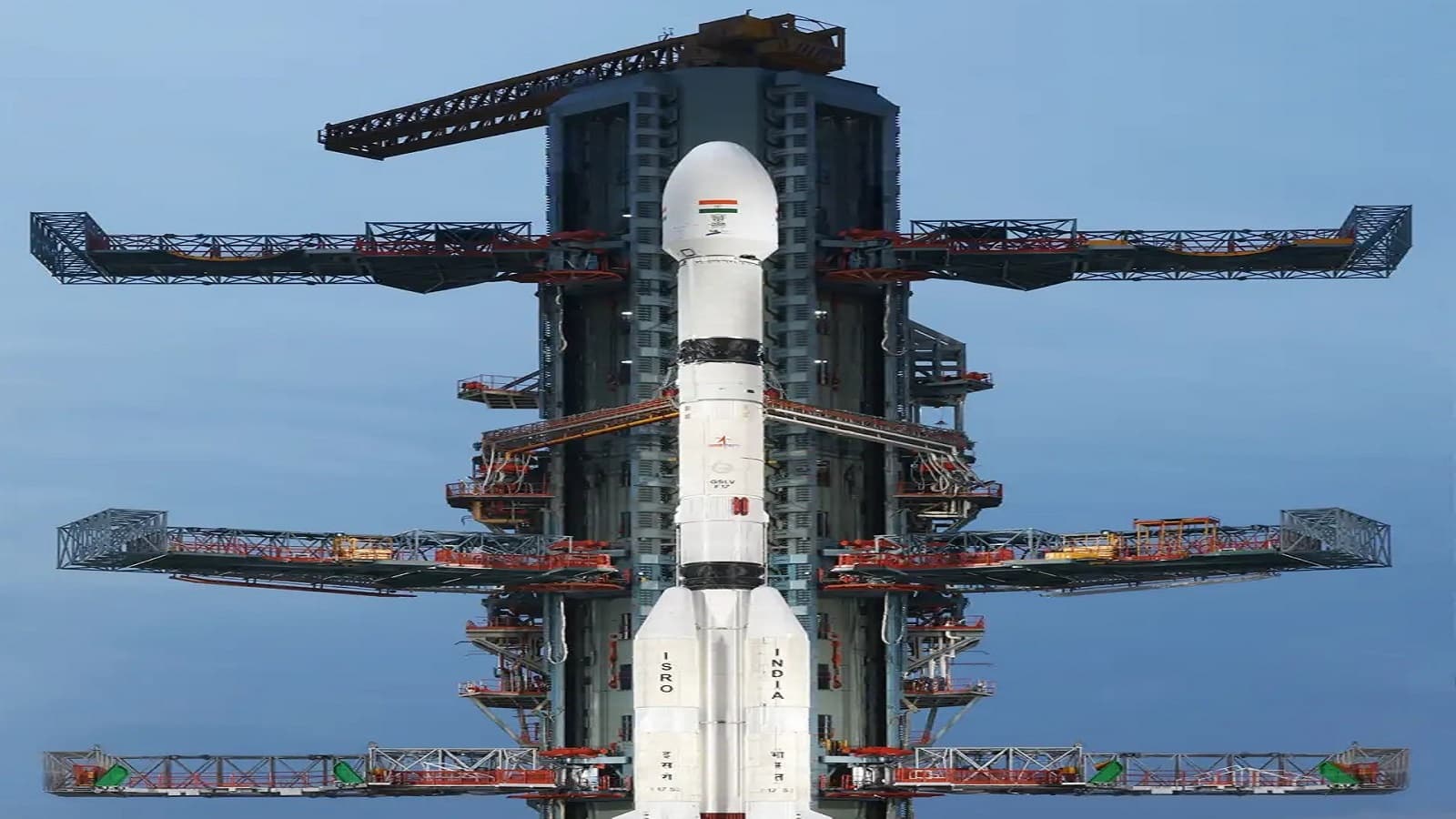
India’s space agency has launched a new geostationary earth observation satellite, EOS-05, that will give the central government persistent surveillance capabilities over the subcontinent and could reshape crisis dynamics with Pakistan, a new report has said. The satellite enables India to persistently track military movements in the subcontinent – especially Pakistan’s naval warships, aircraft, strategic assets movements, and force mobilisation during crisis time, the report from Diplomat said.
The GSLV-F17 rocker on September 4 placed EOS-05 into geosynchronous orbit, allowing continuous observation from roughly 34,900 km to 35,900 km. ISRO chairman V Narayanan said the satellite will become India’s first "dedicated imaging satellite from the geo orbit providing important strategic data for the country.” “The launch of the satellite is part of India’s long-term plan to strengthen its intelligence, surveillance, and reconnaissance (ISR) capabilities,” the report noted. India’s Cabinet Committee on Security (CCS) in 2024 approved the Space Based Surveillance Phase-III (SBS-III) program to deploy 52 defense satellites into low-earth orbit (LEO) and geostationary orbit for surveillance.

ISRO aims to deploy 21 satellites under this project, while the private sector will develop 31 satellites. The Indian strategic community voiced concerns after the May 2025 India-Pakistan crisis to further bolster Indian military capabilities in the space domain. “If we fail in space, we will be forced to fight blind. However, if we dominate in space, we will fight with foresight,” said Former Indian Chief of Defense Staff General Anil Chauhan at the Indian Defense Space Symposium (IDS) 2026.
Currently, India’s satellites are mainly in LEO, where they provide high-resolution imagery but have limitations because of rapid movement across the earth’s surface, but the EOS-05 being in geosynchronous orbit will provide consistent observation of the subcontinent. “This capability will strengthen India’s precision-strike capacity, as precision-strike missiles not only depend on range and accuracy but also timely information regarding the location of targets.
Thus, in the broader sensor-to-shooter chain of network-centric warfare, space-based surveillance would play an important role,” the publication said. As mobile systems rely largely on their concealment, continuous wide-area surveillance, along with high-resolution follow-up, shortens the time between detecting a target and striking it. “India’s growing arsenal of long-range precision-strike missiles may become far more threatening with an added eye in space,” it noted.
Disclaimer: "This story has been published from a syndicated news feed. Only the headline and subtitle have been edited by EPN."