After warning of job losses, Sam Altman says AI is boosting hiring
The OpenAI chief says companies embracing AI are hiring more workers, adding nuance to a debate long dominated by fears of mass job losses and automation-driven layoffs.
EPN Desk02 June 2026 05:40
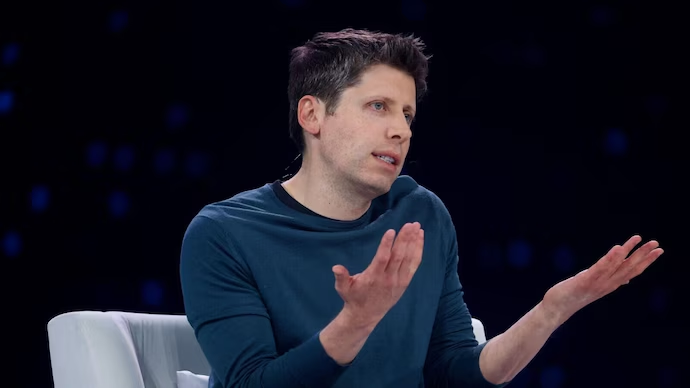
OpenAI CEO Sam Altman has pushed back against the belief that artificial intelligence is causing widespread job cuts, saying companies that have adopted AI most aggressively are also hiring the most workers. His remarks add a new dimension to the debate over whether AI is truly replacing jobs or simply becoming a convenient explanation for layoffs.
"The companies that I know that have adopted AI the most are also the ones hiring the most," Altman said in an interview with CNBC ahead of the groundbreaking ceremony for a massive 1-gigawatt data centre near Detroit.
He argued that the companies most vocal about cutting jobs because of AI are often not the ones leading the technology's adoption.
"And the companies, as a general rule, that are talking about doing layoffs because of AI are the ones adopting AI the least," he said.
From replacing workers to boosting productivity
Altman's remarks reflect a broader shift in the conversation surrounding AI.
Not long ago, predictions of widespread job displacement dominated headlines. Today, a growing number of AI leaders are emphasizing a different possibility: that AI may enhance worker productivity rather than eliminate the need for human employees.
Altman said his own thinking has evolved after observing how businesses use OpenAI's tools, particularly coding assistant Codex.
"I think I underestimated how jagged these models are going to be," he said.
According to Altman, AI systems excel at specific tasks but continue to struggle with long-term planning, oversight and managing complex projects from beginning to end. Those limitations, he suggested, make human involvement indispensable in many workplaces.
Is AI becoming a convenient excuse?
Altman also criticized what he described as "AI washing" — attributing workforce reductions to artificial intelligence even when the technology may not be the primary cause.
He suggested that AI can sometimes serve as a convenient explanation for layoffs that companies may have pursued regardless of technological changes.
That does not mean AI poses no risk to employment. Altman acknowledged that the long-term impact of the technology remains uncertain. However, his latest comments signal a noticeably more optimistic outlook than some of the warnings that accompanied the early AI boom.
A turning point after a violent attack
The shift in tone follows a deeply personal episode for Altman.
In April, he survived an attack in which a man allegedly threw a Molotov cocktail at him with the intent to kill. Authorities said the suspect was motivated by hostility towards artificial intelligence.
After the incident, Altman addressed the growing public anxiety around the technology, acknowledging that concerns about AI are understandable.
"We are in the process of witnessing one of the largest changes to society in a long time, and perhaps ever," he said.
At the same time, he suggested that public debate has occasionally overstated AI's current capabilities and immediate impact.
Reassessing AI's biggest claims
Altman also acknowledged that OpenAI may have contributed to fears surrounding job losses through some of its own messaging.
He cited a December press release about GPT-5.2 that claimed the model "outperforms professionals across 44 occupations." In hindsight, Altman said the company should have communicated the achievement more precisely.
"What I wish we had said then is that it outperforms professionals at small tasks in 44 occupations," he said.
A more nuanced debate emerges
The conversation around AI's impact on jobs is becoming increasingly complex as adoption accelerates.
Following the attack on Altman, OpenAI's global policy chief, David Lehane, said the company must do a better job explaining both the opportunities and risks associated with artificial intelligence. He warned that irresponsible public discourse around the technology can have real-world consequences.
As AI continues to reshape workplaces, the debate is shifting away from simple predictions of job destruction towards a more nuanced question: whether the technology will replace workers, empower them, or ultimately do a bit of both.







.jfif&w=256&q=75)





.webp&w=256&q=75)
