Academic Boundaries Fade as India’s Higher Education Shifts Toward a Flexible Learning Era
India’s universities are transitioning toward flexible, multidisciplinary learning models driven by NEP 2020, reshaping academic structures, student mobility, employability outcomes, and institutional governance across higher education systems nationwide, writes Pragya Kumari.
Pragya Kumari14 May 2026 10:48
“Wisdom is not a product of schooling but of the lifelong attempt to acquire it.” -Albert Einstein
India’s higher education system is undergoing a structural transformation as flexible study models begin to replace rigid academic pathways. Driven by the National Education Policy 2020 and subsequent regulatory changes, universities are moving toward systems that allow greater student choice, mobility, and interdisciplinary learning.
This shift is not only changing how degrees are structured but also reshaping everyday student life, academic planning, and institutional governance.
A System Built on Scale Faces Pressure to Evolve
India currently has one of the largest higher education ecosystems in the world. According to the All India Survey on Higher Education 2021 to 2022, there are more than 1,100 universities and over 43,000 colleges, with total student enrollment crossing 43 million.
Despite this scale, the system has historically struggled with low participation and high dropout rates. The gross enrollment ratio stands at about 28.4%, well below the national target of 50% by 2035. A rigid academic structure, limited flexibility in course selection, and lack of mobility between institutions have been key factors behind these challenges.
Policy Reforms Introduce Flexibility into Academic Pathways
Flexible study models aim to address these gaps by redesigning how students progress through higher education. One of the most significant reforms is the introduction of multiple entry and exit options. Students can now leave a program after one year with a certificate, after two years with a diploma, or complete three or four years for a full degree.
This system allows students to pause and resume education without losing progress, which is particularly relevant in a country where financial and social constraints often interrupt academic journeys.
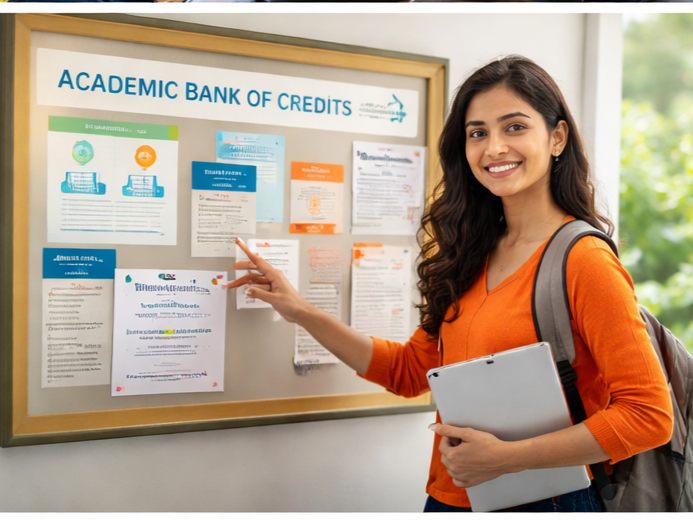
Another major reform is the Academic Bank of Credits, a digital system that enables students to store and transfer academic credits across institutions. By 2025, millions of students had registered on this platform, although active usage varies across universities.
In principle, a student can begin a course at one institution, earn credits through online platforms or partner universities, and complete the degree elsewhere. This represents a major shift from the traditional model where degrees were tied to a single institution.
Curriculum and Learning Experience Undergo Transformation
The curriculum itself is also changing. Universities are increasingly adopting multidisciplinary structures and modular courses. The Choice Based Credit System allows students to select subjects beyond their primary discipline.
Engineering students are taking courses in economics and design, while humanities students are exploring data science and digital skills. This approach reflects the changing demands of the job market, where employers value adaptability and cross-disciplinary knowledge.
These reforms are directly influencing student life. A growing number of students are combining classroom learning with online courses, internships, and certifications. Government platforms such as SWAYAM now offer more than 2,000 courses, with millions of enrollments recorded.
At the same time, private platforms continue to expand, and India’s online education market is projected to reach 10 billion dollars by 2026.
As a result, learning is no longer confined to the physical campus. Students are building personalized academic pathways that extend beyond university boundaries.
Flexibility Redefines Campus Life and Social Dynamics
Surveys indicate that this shift is being welcomed by students. A 2024 study found that more than 60% of university students preferred flexible or hybrid learning formats, citing better time management and broader learning opportunities. However, this flexibility also alters the social fabric of campus life.
Traditional cohort systems are weakening as students progress at different speeds and follow individualized course combinations. While this enhances personalization, it can reduce the sense of shared academic experience that once defined university life.
Employability Gains Drive the Push Toward Flexible Learning
The impact of flexible study models is also visible in employment outcomes. India produces close to 10 million graduates each year, but employability remains a concern. Several industry reports suggest that only around 45% of graduates are job ready.
Flexible systems allow students to integrate internships and skill-based certifications into their academic journey, which can improve their readiness for the workforce. A 2025 industry report highlighted that students who combined degrees with practical training had significantly higher placement rates compared to those following traditional academic paths.
Implementation Challenges Persist Across Institutions
Despite these advantages, the transition is uneven. Many universities face administrative and infrastructural challenges in implementing flexible systems. Credit transfer mechanisms are not always seamless, and differences in curriculum design can create confusion.
Faculty members often require additional training to handle interdisciplinary teaching, and existing evaluation systems are not fully aligned with modular learning.
A review by regulatory authorities found that while a majority of institutions have formally adopted flexible frameworks, only a smaller proportion have implemented them effectively.
There are also concerns about academic depth and quality. Critics argue that excessive flexibility may lead to fragmented learning, where students accumulate credits without developing strong expertise in a particular field. Ensuring academic rigor while offering choice remains a key challenge for universities and regulators.
Governance and Regulation Shape the Future of Flexibility
Governance plays a critical role in this transition. Flexible study models require coordination between multiple institutions, standardization of credit systems, and robust digital infrastructure.
Regulatory bodies are working to establish common frameworks, but the diversity of India’s higher education landscape makes uniform implementation complex. Data security and privacy are additional concerns, as digital platforms store large volumes of student information.
Wellbeing and Inclusion Remain Central to the Transition
The shift toward flexibility also has implications for student wellbeing. While increased choice can be empowering, it also places greater responsibility on students to plan their academic paths.
This can lead to uncertainty and decision-related stress, particularly for first-generation learners who may lack access to guidance. A recent survey indicated that more than half of university students experience anxiety related to academic and career decisions.
Universities are expanding counseling and advisory services, but these efforts are still developing.
At the same time, flexible models have the potential to improve inclusion. Students who need to work or manage personal responsibilities can benefit from modular and part-time learning options. The ability to pause and resume education makes higher education more accessible to a wider population.
However, the benefits are not evenly distributed. Limited access to digital resources and uneven institutional capacity mean that students in rural or under resourced areas may not fully benefit from these reforms.
A System in Transition with Long-Term Implications
The rise of flexible study models represents a significant departure from the traditional structure of higher education in India. It reflects a broader shift toward a system that prioritizes adaptability, lifelong learning, and student agency.
At the same time, it highlights the need for careful implementation, strong governance, and continuous investment in infrastructure and support systems.
As India works toward expanding its higher education base and improving quality, flexible study models are likely to play a central role. Their success will depend on how well institutions balance freedom with structure, innovation with consistency, and access with quality.
For students, the transformation offers new opportunities, but it also demands greater awareness and responsibility in navigating an increasingly complex educational landscape.