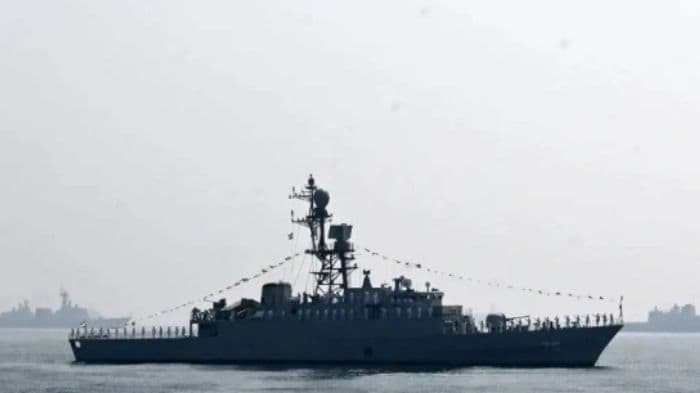
The sinking of the Iranian warship IRIS Dena in the Indian Ocean has triggered fresh debate about India’s role and jurisdiction in waters that bear its name.
The vessel was reportedly torpedoed by a US Navy submarine on March 4 in waters near Sri Lanka while returning to Iran after participating in a naval exercise in India. The strike occurred roughly 40 nautical miles south of the Sri Lankan city of Galle, an area considered international waters where multiple countries operate under maritime law.

Experts note that the Indian Ocean is named after India because of the country’s geographical centrality and the way the Indian peninsula extends into the ocean. However, the name does not imply ownership or control by India.
Under the United Nations Convention on the Law of the Sea (UNCLOS), coastal countries have limited maritime jurisdiction rather than full control over oceans. Territorial waters extend up to 12 nautical miles from a nation’s coastline, while the Exclusive Economic Zone (EEZ) extends up to 200 nautical miles, allowing countries to manage natural resources such as fish, oil and gas in those areas.
Beyond these zones lie international waters, often referred to as the high seas, where no country has sovereignty and all nations enjoy freedom of navigation and military passage under international law.
India’s EEZ covers about 2.3 million square kilometres, making it one of the larger maritime zones in the world. The country’s island territories, including the Andaman and Nicobar Islands and Lakshadweep, further extend its strategic reach across important sea lanes.
Despite this influence, the Indian Ocean is shared by many countries, including Sri Lanka, Indonesia, Australia and several African and Middle Eastern nations. As a result, control of the region depends more on naval presence and strategic partnerships than legal ownership.
The IRIS Dena incident has therefore highlighted the limits of India’s authority in the region, even as New Delhi positions itself as a key security player in the Indian Ocean.