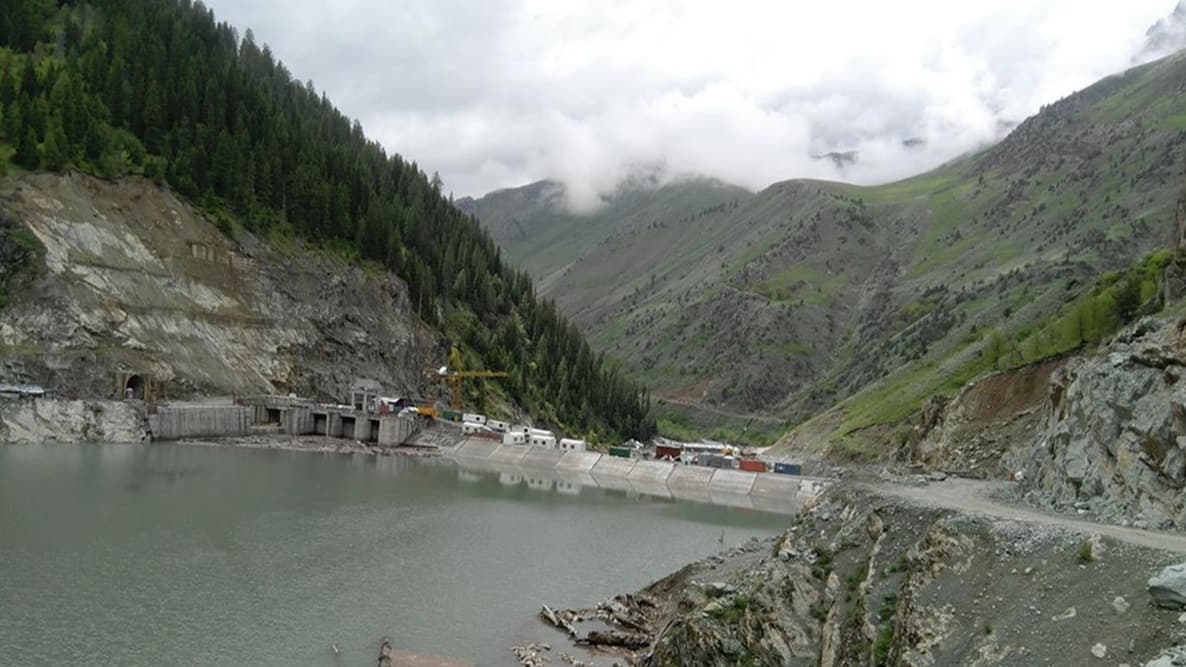
In a decisive shift in its Indus waters strategy, the Government of India has begun monthly flushing operations at the Salal and Baglihar dams — two of its major hydroelectric power projects on the Chenab River — after placing the decades-old Indus Waters Treaty (IWT) in abeyance. The move comes in the wake of the April 22 terror attack in Pahalgam, which Delhi has attributed to cross-border support from Pakistan.
Top officials were quoted as confirming that the Central Water Commission (CWC) has now recommended that these sediment-clearing exercises be institutionalized as a monthly routine. This marks a significant policy shift after decades of Pakistani objections under the IWT effectively stalled such operations.

The government initiated the first flushing operations at the 690 MW Salal and 900 MW Baglihar reservoirs earlier this month. These cleared more than 7.5 million cubic metres (MCM) of accumulated sediment — a build-up of silt, sand, and clay that had been choking turbine efficiency and reducing storage capacity.
“This is about restoring power output, securing water rights, and asserting national interest,” a senior official said, adding that a standard operating procedure (SOP) for monthly flushing is being finalized.
Tactical shift after treaty freeze
The flushing push is part of a broader short-term strategy aimed at maximizing India’s use of the Indus waters after the IWT was effectively frozen. Signed in 1960 after nine years of negotiation, the treaty divides the six-river Indus system between the two countries, granting Pakistan control over the Indus, Jhelum, and Chenab, while India retained unrestricted access to the Sutlej, Beas, and Ravi.
With the treaty suspended, India is no longer obligated to notify Pakistan of hydrological data or reservoir management operations — including flushing. Pakistan has long objected to flushing, citing concerns over sudden surges in downstream water flow followed by reduced availability during the recharge phase. However, with the treaty on hold, these constraints no longer apply.
“For decades, we had to inform Pakistan six months in advance for any new project under the IWT. That obligation is off the table,” the official added.
Power surge: Projects back on track
In parallel, the government is preparing to accelerate stalled hydroelectric ventures previously hampered by Pakistani objections under the treaty. These include the 1,000 MW Pakal Dul, 624 MW Kiru, 540 MW Kwar, and 850 MW Ratle projects — all located on the Chenab River.
Plans to divert certain Indus flows and explore new dam construction are also under active consideration, signaling a medium- and long-term pivot in India’s water policy posture.
Diplomatic undercurrents
Notably, Pakistan — after months of diplomatic reticence — has responded to India’s April 24 notification formally placing the treaty in abeyance. Islamabad has now expressed willingness to enter talks, offering a date in May for discussions on Delhi’s concerns. This is the first explicit gesture of dialogue following two prior Indian notices in 2023 and 2024 seeking treaty modifications.
Still, officials in Delhi remain firm: “Until Pakistan credibly and irrevocably ceases its support for cross-border terrorism, the treaty remains suspended.”
A new chapter in the Indus saga
The IWT, often hailed as a rare success story of India-Pakistan cooperation, now finds itself in uncharted waters. What began as a technical agreement rooted in river management has become a high-stakes lever of geopolitical pressure.
And with the sediment now flowing freely down the Chenab once more — month after month — the message from Delhi is clear: the tide is turning.