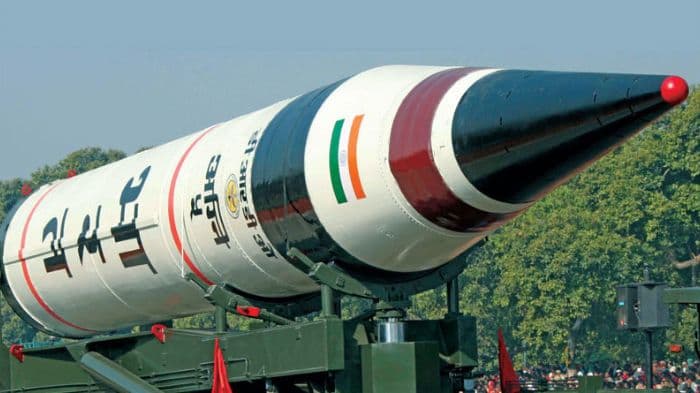
India successfully test-fired its nuclear-capable Agni-5 intermediate-range ballistic missile (IRBM) with a maximum range of 5,000 km, from the Integrated Test Range in Chandipur, Odisha.
The launch “validated all operational and technical parameters,” according to the Ministry of Defence, and was conducted under the auspices of the Strategic Forces Command.

With a strike envelope extending across nearly the entirety of Asia and parts of Europe, the Agni-5 significantly expands India’s long-range strike capability. It now ranks among the most advanced missiles in South Asia.
India’s Agni missile family, ranging from Agni-I (700–900 km) to Agni-IV (4,000 km), has been steadily modernized. The Agni-5, utilizing a three-stage solid-fuel design, incorporates advanced guidance systems and mobility enhancements, including canister-based launch capability, making it more agile and quicker to deploy than its predecessors.
In regional terms, the Agni-5 puts Pakistan's longest-range missile, the Shaheen-III—with a maximum range of approximately 2,750 km—well within its surveillance.
Defense analysts note that the test follows closely on India's launch of other ballistic systems, including Prithvi-II and Agni-I, further signaling growing sophistication in its strategic arsenal.
Firstpost commentary highlights that Agni-5's capability to strike deep into China is a clear strategic signal amid shifting geopolitical landscapes. Although some experts speculate its true range could extend up to 8,000 km, this remains unconfirmed.
While broadly interpreted as a defensive deterrent, such demonstrations inevitably influence regional stability.
A former Pakistani Air Force pilot told Reuters that India’s boosted missile potency raises strategic stakes, potentially increasing peril during border incidents in the absence of effective deterrence models.





.jpg&w=256&q=75)