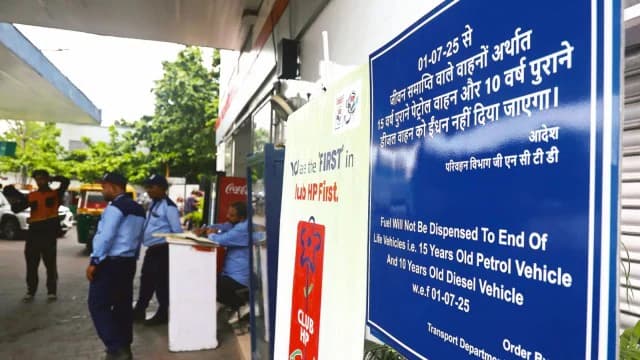
In a major policy pivot, the Delhi government has moved the Supreme Court seeking a review of its 2018 order that imposed a blanket ban on petrol vehicles older than 15 years and diesel vehicles over 10 years in the National Capital Region (NCR).
The plea, filed on July 25, urges the court to consider a scientific, technology-driven framework instead of age-based restrictions, citing significant progress in emission controls and evolving environmental dynamics.

A bench led by Chief Justice of India B R Gavai is scheduled to hear the matter on July 28.
In its application, the government argues that the existing blanket ban — though well-intentioned — has led to “numerous practical hardships” for residents. It maintains that vehicle age alone is an insufficient metric to determine pollution potential, and that a more nuanced approach rooted in actual emission data and vehicle fitness is now both feasible and necessary.
“Road-worthiness is a scientific issue, best assessed through actual emissions testing and not arbitrarily by vehicle age,” the petition contends, citing provisions of the Motor Vehicles Act and Central Motor Vehicles Rules.
The AAP-led administration highlights that sweeping changes since the original 2018 order — including a nationwide shift to Bharat Stage VI (BS-VI) emission norms, wider implementation of Pollution Under Control (PUC) certification, and improved monitoring — merit a fresh scientific evaluation.
A call for a balanced, evidence-based policy
The government’s plea calls on the Supreme Court to direct the Union government or the Commission for Air Quality Management (CAQM) to commission a “broad-based, scientific study” on the effectiveness and necessity of continuing with the blanket ban. It proposes a shift toward a "graded, balanced and technology-driven regime" that factors in real-time emissions, mileage, fitness tests, and retrofitting options such as CNG or electric conversions.
“A balanced policy would protect the environment while safeguarding the rights of responsible vehicle owners,” the plea emphasizes.
Citing broader pollution dynamics
The Delhi government also underscored that vehicular emissions are just one piece of the capital’s complex pollution puzzle. It cited studies by the CAQM, which attribute significant seasonal fluctuations in air quality to sources such as stubble burning, construction dust, industrial emissions, and meteorological conditions.
In this context, the government argued, singling out vehicle age without holistic data could be counterproductive. “A cost-benefit analysis of phasing out vehicles based purely on age is necessary,” the petition stated, pointing to seasonal variations in pollution sources as acknowledged in CAQM’s own 2022 policy document.
Seeking re-evaluation post BS-VI era
Crucially, the government stressed that the 2018 ban was introduced during the BS-IV emission standard era — before the rollout of BS-VI norms, which significantly tightened emission limits. With the transition complete, it argued, a reevaluation is overdue.
“Substantial legal, technological, and environmental developments since 2018 call for a structured and expert-led reexamination of the ban,” the application concluded.
As Delhi continues to grapple with hazardous air quality, the outcome of this plea could shape the next phase of vehicular policy — potentially shifting the narrative from age-based bans to scientific accountability.