The team led by Indian scientists (Prof. Sudip Bhattacharyya) finds X-ray signature of boundary around black holes
EPN Desk23 September 2020 12:11
Although black holes don't have a surface, it is confined within an invisible boundary, called an event horizon, from within which nothing, not even light, can escape, the scientists said.
A black hole is an exotic cosmic object, from within which nothing, not even light, can escape. Definitive proof of the existence of such objects is a holy grail of physics and astronomy. An international team of astrophysicists, consisting of Mr. Srimanta Banerjee, Professor Marat Gilfanov, Professor Sudip Bhattacharyya, and Professor Rashid Sunyaev, has found by far the strongest steady signature of stellar-mass black holes to date, from the cosmic X-rays observed with a satellite.
A team of international scientists, led by those from India, has found a distinctive signature of cosmic X-rays to identify the boundary around black holes, which “unmistakably separate them” from other objects in the cosmos such as neutron stars that are comparable in mass and size.
According to the astrophysicists, including Prof. Sudip Bhattacharyyafrom the Tata Institute of Fundamental Research (TIFR) in Mumbai, the current discovery is by far the strongest steady signature of the smaller, but more extreme stellar-mass black holes to date, from the cosmic X-rays, observed with a satellite.
Although black holes don’t have a surface, it is confined within an invisible boundary, called an event horizon, from within which nothing, not even light, can escape, the scientists said.
While definitive proof of the existence of such objects is a holy grail of modern physics and astronomy, they said only one supermassive black hole with the mass more than six billion times the mass of the Sun has so far been imaged using the surrounding radiation in radio wavelengths.
But according to the study, accepted for publication in the journal Monthly Notices of the Royal Astronomical Society, understanding stellar-mass black holes, which have masses about ten times that of the Sun, is indispensable to probe some of the extreme aspects of the cosmos.
In order to prove the existence of these stellar-mass black holes, the researchers said these need to be distinguished from neutron stars which are the densest known objects in the universe with a hard surface.
While the stable stellar-mass black holes shine mainly in X-rays by devouring material from a companion star, the study noted that neutron stars can also shine in X-rays by accreting matter from a companion star in a similar way.
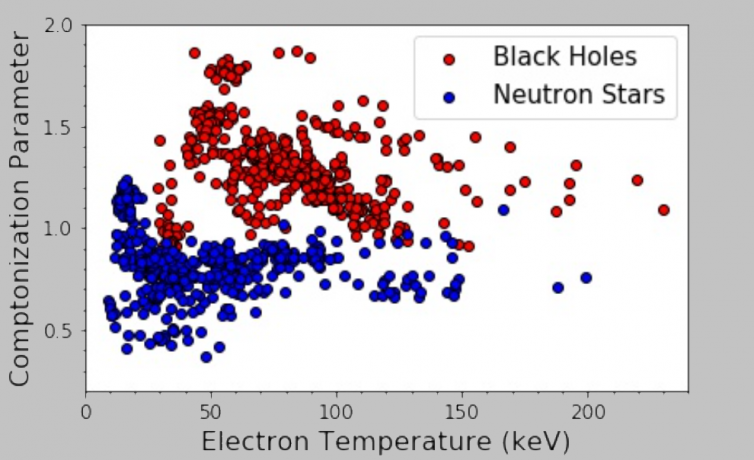
In the current study, the scientists analyzed archival data from the now decommissioned astronomy satellite Rossi X-Ray Timing Explorer, and have identified the effect of the lack of hard surface in black holes on their observed X-ray emission.
From these analyses, they have found an extremely strong signature of accreting stellar-mass black holes.
“The study has found by far the strongest steady signature of smaller, but more extreme, black holes to date, from the cosmic X-rays, observed with a satellite,” Bhattacharyya told PTI in an email.