


From building premier institutions to implementing landmark policies, successive governments have reshaped education, yet recurring examination crises and implementation gaps continue to test public confidence.
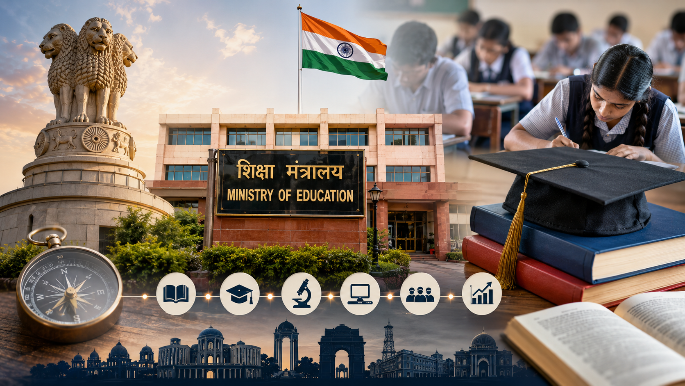
Nearly eight decades after Independence, India's education system stands at a crossroads. Despite successive governments introducing landmark policies, expanding premier institutions, and rolling out sweeping reforms, recurring paper leaks, governance lapses, institutional vacancies, and implementation challenges continue to cast a shadow over the sector.
The resignation of Union Education Minister Dharmendra Pradhan on July 25, 2026, following nationwide protests over examination paper leaks and demands for accountability, has once again brought the effectiveness of India's education reforms into sharp focus.

Pralhad Joshi has been given the additional charge of the Ministry of Education while continuing to head the Ministries of Consumer Affairs, Food and Public Distribution, and New and Renewable Energy.
The change in leadership comes as the ministry faces growing pressure to restore confidence in the country's examination system and address long-standing structural issues that have persisted despite decades of policy interventions.
The Ministry of Education, headed by a Union Cabinet minister, is responsible for framing national education policies, improving school and higher education, promoting research and innovation, strengthening teacher education, and expanding access to quality education across the country.
From Independence to reforms
Since 1947, India has had more than 30 Education Ministers, each introducing reforms aimed at strengthening different aspects of the education system.
Maulana Abul Kalam Azad, India's first Education Minister, laid the foundation of the country's modern education framework. During his tenure from 1947 to 1958, he promoted universal primary education, adult literacy, women's education, scientific research, and technical education.
He also played a key role in establishing the University Grants Commission (UGC), supported the development of the Indian Institutes of Technology (IITs), and encouraged the creation of institutions such as the Indian Council for Cultural Relations (ICCR), Sahitya Akademi, Sangeet Natak Akademi, and Lalit Kala Akademi.
His birth anniversary on November 11 is observed every year as National Education Day.
Subsequent ministers continued expanding the education system through new institutions, literacy programs, teacher training, curriculum reforms, and higher education initiatives.
Dr. K. L. Shrimali focused on improving rural education and teacher training, while Dr. Triguna Sen strengthened technical education during a period that saw the recommendations of the Kothari Commission shape the National Policy on Education, 1968.
Dr. V. K. R. V. Rao promoted research-based educational planning, while S. Nurul Hasan expanded academic and research institutions, including the Indian Council of Historical Research (ICHR).
Sheila Kaul emphasized girls' education and wider access to primary schooling.
Complete List of Education Ministers of India | |
Education Minister | Tenure |
| Maulana Abul Kalam Azad | 15 August 1947 – 2 February 1958 |
| Dr. K. L. Shrimali | 22 February 1958 – 31 August 1963 |
| Humayun Kabir | 1 September 1963 – 21 November 1963 |
| M. C. Chagla | 21 November 1963 – 13 November 1966 |
| Fakhruddin Ali Ahmed | 14 November 1966 – 13 March 1967 |
| Dr. Triguna Sen | 16 March 1967 – 14 February 1969 |
| Dr. V. K. R. V. Rao | 14 February 1969 – 18 March 1971 |
| Siddhartha Shankar Ray | 18 March 1971 – 20 March 1972 |
| S. Nurul Hasan | 24 March 1972 – 24 March 1977 |
| Pratap Chandra Chunder | 26 March 1977 – 28 July 1979 |
| Dr. Karan Singh | 30 July 1979 – 14 January 1980 |
| B. Shankaranand | 14 January 1980 – 17 October 1980 |
| S. B. Chavan | 17 October 1980 – 8 August 1981 |
| Sheila Kaul | 8 August 1981 – 31 December 1984 |
| K. C. Pant | 31 December 1984 – 25 September 1985 |
| P. V. Narasimha Rao | 25 September 1985 – 25 June 1988 |
| P. Shiv Shankar | 25 June 1988 – 2 December 1989 |
| V. P. Singh (Additional Charge) | 2 December 1989 – 10 November 1990 |
| Rajmangal Pandey | 21 November 1990 – 21 June 1991 |
| Arjun Singh | 23 June 1991 – 24 December 1994 |
| P. V. Narasimha Rao | 24 December 1994 – 9 February 1995 |
| Madhavrao Scindia | 9 February 1995 – 17 January 1996 |
| P. V. Narasimha Rao | 17 January 1996 – 16 May 1996 |
| Murli Manohar Joshi | 16 May 1996 – 1 June 1996 |
| S. R. Bommai | 5 June 1996 – 19 March 1998 |
| Murli Manohar Joshi | 19 March 1998 – 22 May 2004 |
| Arjun Singh | 23 May 2004 – 22 May 2009 |
| Kapil Sibal | 28 May 2009 – 28 October 2012 |
| M. M. Pallam Raju | 28 October 2012 – 26 May 2014 |
| Smriti Irani | 26 May 2014 – 5 July 2016 |
| Prakash Javadekar | 5 July 2016 – 30 May 2019 |
| Ramesh Pokhriyal ‘Nishank’ | 30 May 2019 – 7 July 2021 |
| Dharmendra Pradhan | 7 July 2021 – 25 July 2026 (Resigned) |
| Pralhad Joshi | 25 July 2026 – Present |
Major policy milestones
One of the biggest turning points came under P. V. Narasimha Rao, who introduced the National Policy on Education (NPE), 1986. The policy focused on universal elementary education, teacher training, women's education, adult literacy, and vocational education.
The period also witnessed the launch of Jawahar Navodaya Vidyalayas, Operation Blackboard, and District Institutes of Education and Training (DIETs).
During his two tenures, Arjun Singh expanded higher education by establishing more Central Universities, IITs, IIMs, and IISERs. His second tenure also coincided with key developments leading to the Right of Children to Free and Compulsory Education Act, 2009.
Murli Manohar Joshi expanded the Sarva Shiksha Abhiyan (SSA), promoted science education, and introduced the National Curriculum Framework (NCF), 2000.
Kapil Sibal implemented the Right to Education (RTE) Act, introduced the Continuous and Comprehensive Evaluation (CCE) system and the CGPA-based grading system for CBSE Class 10 students, while promoting technology-enabled learning.
M. M. Pallam Raju focused on teacher education, institutional quality, and skill development.
Smriti Irani promoted digital education initiatives and began work on drafting a new National Education Policy.
Prakash Javadekar expanded digital learning through initiatives such as DIKSHA while encouraging research and innovation.
Ramesh Pokhriyal 'Nishank' oversaw the approval of the National Education Policy (NEP) 2020 and the renaming of the Ministry of Human Resource Development (MHRD) back to the Ministry of Education.
Dharmendra Pradhan led the implementation of NEP 2020 through initiatives including PM SHRI Schools, the National Curriculum Framework, Academic Bank of Credits, National Credit Framework, multilingual education, and research promotion through the Anusandhan National Research Foundation (ANRF).
However, his tenure concluded with his resignation amid nationwide protests over paper leaks and demands for accountability.
Ministry's changing identity
India established the Ministry of Education on August 15, 1947.
In 1985, the Rajiv Gandhi government renamed it the Ministry of Human Resource Development (MHRD), combining education with culture, youth affairs, and sports.
The ministry regained its original name on July 29, 2020, after the approval of the National Education Policy 2020.
At present, it functions through two departments: the Department of School Education and Literacy and the Department of Higher Education.
Key national reforms
India's education system has undergone several landmark reforms over the decades.
The National Policy on Education, 1968, based on the Kothari Commission, introduced the three-language formula and recommended free and compulsory education up to the age of 14.
The National Policy on Education, 1986, later modified in 1992, emphasized equality in education, Operation Blackboard, and expansion of Jawahar Navodaya Vidyalayas.
The Right to Education Act, 2009, made free and compulsory education a fundamental right for children aged six to 14.
The National Education Policy, 2020, replaced the 34-year-old education policy, introduced the 5+3+3+4 school structure, promoted multidisciplinary education and vocational integration, and restored the ministry's original name.
BJP era: Reforms and controversies
With Pralhad Joshi assuming additional charge, five leaders have now handled the education portfolio during the BJP-led government's 12 years in office.
Smriti Irani, who served from 2014 to 2016, rolled back Delhi University's Four-Year Undergraduate Programme (FYUP), initiated work on the NEP, and launched the National Institutional Ranking Framework (NIRF).
Her tenure also witnessed controversies surrounding the JNU protests and the death of Hyderabad University research scholar Rohith Vemula.
Prakash Javadekar, who succeeded Irani, introduced the IIM Act, 2017, established the National Testing Agency (NTA), and amended the Right to Education Act by ending the mandatory No Detention Policy.
His tenure, however, was marked by the 2018 CBSE paper leak controversy and criticism over the Institution of Eminence status granted to the proposed Jio Institute.
Ramesh Pokhriyal 'Nishank' secured Cabinet approval for NEP 2020 but also faced criticism as several Central Universities and IITs functioned without permanent vice chancellors and directors. He resigned in July 2021, citing health reasons.
Dharmendra Pradhan became the longest-serving Education Minister under the NDA government. While he led the implementation of NEP 2020 and introduced multiple reforms across school and higher education, his tenure increasingly came under criticism over repeated examination irregularities, paper leaks, and the cancellation of competitive examinations.
The latest change in leadership has once again highlighted the gap between policymaking and implementation.
Successive governments have introduced ambitious education reforms, established premier institutions, expanded access to schooling, strengthened higher education, and promoted digital learning. Yet recurring examination controversies, governance concerns, faculty shortages, delays in institutional appointments, and implementation gaps continue to raise questions over the effectiveness of those reforms.
With Pralhad Joshi taking charge at a time of heightened public scrutiny, the ministry faces the immediate challenge of restoring credibility to India's examination system while ensuring that decades of education reforms translate into measurable improvements in governance, learning outcomes, and institutional accountability.

China shuts three Tibetan schools, raising fears for language and cultural identity
UP STF to Verify Certificates of Classes 1–8 Teachers; Allahabad HC Warns Officials Against Laxity

AP Inter Exams 2027: BIE Revises Answer Booklets, Biology OMR Sheets

Australia opens national youth survey to shape new government strategy

Irish universities seek more state funding amid €250 million shortfall
China shuts three Tibetan schools, raising fears for language and cultural identity

CCPA reports 3,940 delistings in crackdown on online sale of explosive substances
UGC seeks governors’ intervention as 82 Tamil Nadu institutions face 150 fee-refund complaints
Engineering Must Build Foundations, Not Chase Every Trend: Dr. Arya Kumar Bhattacharya

France protests escalate as Macron rejects minister’s resignation, students block Louvre
China shuts three Tibetan schools, raising fears for language and cultural identity
UP STF to Verify Certificates of Classes 1–8 Teachers; Allahabad HC Warns Officials Against Laxity
AP Inter Exams 2027: BIE Revises Answer Booklets, Biology OMR Sheets
Australia opens national youth survey to shape new government strategy
Irish universities seek more state funding amid €250 million shortfall
China shuts three Tibetan schools, raising fears for language and cultural identity
CCPA reports 3,940 delistings in crackdown on online sale of explosive substances
UGC seeks governors’ intervention as 82 Tamil Nadu institutions face 150 fee-refund complaints
Engineering Must Build Foundations, Not Chase Every Trend: Dr. Arya Kumar Bhattacharya
France protests escalate as Macron rejects minister’s resignation, students block Louvre
Copyright© educationpost.in 2026 All Rights Reserved.