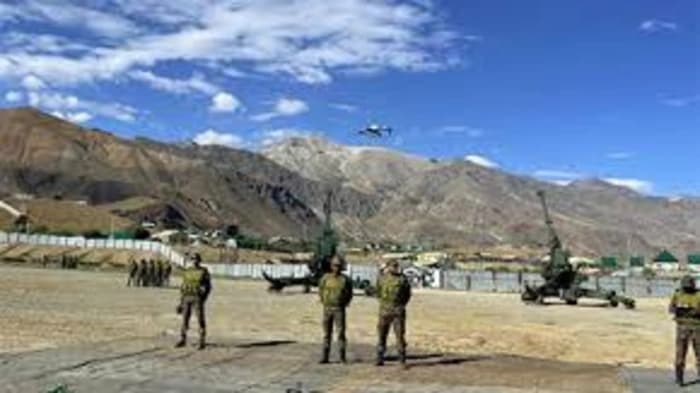
The Indian Army effectively carried out Exercise Divya Drishti in East Sikkim to evaluate AI-driven battlefield awareness, real-time monitoring, and advanced warfare technologies in high-altitude operational settings

What is Divya Drishti Exercise?
A technology demonstration at high altitude by the Indian Army, designed to validate AI-driven surveillance, instant decision-making, and sensor-to-shooter systems in authentic combat scenarios.

Inaugurated by: Trishakti Corps of the Indian Army.
Goals:
Evaluate battlefield digital tools in challenging Himalayan landscapes.
Combine AI sensors with communication networks to ensure effortless data transfer.
Confirm the collaboration between UAVs, drones, and ground forces in combat situations.
Promote strategies for future combat, in accordance with Atmanirbhar Bharat and the Army’s Decade of Transformation plan.
Characteristics:
Practical Implementation: Ground platforms, drones, and UAVs mimicked operational tasks in East Sikkim.
AI-Powered Sensors: Utilized for producing battlefield insights, charting landscapes, and improving situational awareness instantaneously.
Sensor-to-Shooter Connection: Allowed immediate data relay from surveillance equipment to command centers and weaponry units.
Protected Communications: Connected communication networks facilitated seamless transmission of tactical information.
Technologies for the Future: In harmony with native defense advancements under the Atmanirbhar Bharat program.
Importance:
Enhances Tactical Preparedness: Equips the Army for hybrid warfare in varied terrains — notably in Himalayan conflict areas.
Encourages Self-Sufficiency: Advocates for Make in India in defense technology, decreasing reliance on foreign imports.
Enhances Decision Velocity: Reduces command delay via AI-powered situational evaluation and immediate reactions.

India’s Blue Economy Push Seeks to Balance Growth and Ocean Conservation

Supreme Court Seeks Panel to Curb Unethical Pharma Marketing Practices

NMC Tightens Rules on Doctors’ Digital Advertising and AI Use

Anthropic Launches Claude Haiku 5.5 as Its Fastest and Cheapest AI Model

Karnataka HC Replaces ‘Visitation’ with ‘Parenting Time’ in Child Custody Cases

Canadian author Anne Carson wins 2026 Nobel Prize in Literature for reshaping contemporary literary forms

AMU students’ protest enters third week as union election demand widens

DPDP Act Explained: What is India’s Digital Personal Data Protection Law and Why is it in the News?

IIT Bombay puts stricter cheating rules on hold, drafts new procedure for exam misconduct

Gujarat launches PARAKH Cell to shift school assessments toward competency-based learning

India’s Blue Economy Push Seeks to Balance Growth and Ocean Conservation

Supreme Court Seeks Panel to Curb Unethical Pharma Marketing Practices

NMC Tightens Rules on Doctors’ Digital Advertising and AI Use

Anthropic Launches Claude Haiku 5.5 as Its Fastest and Cheapest AI Model

Karnataka HC Replaces ‘Visitation’ with ‘Parenting Time’ in Child Custody Cases

Canadian author Anne Carson wins 2026 Nobel Prize in Literature for reshaping contemporary literary forms

AMU students’ protest enters third week as union election demand widens

DPDP Act Explained: What is India’s Digital Personal Data Protection Law and Why is it in the News?

IIT Bombay puts stricter cheating rules on hold, drafts new procedure for exam misconduct

Gujarat launches PARAKH Cell to shift school assessments toward competency-based learning
Copyright© educationpost.in 2024 All Rights Reserved.
Designed and Developed by @Pyndertech