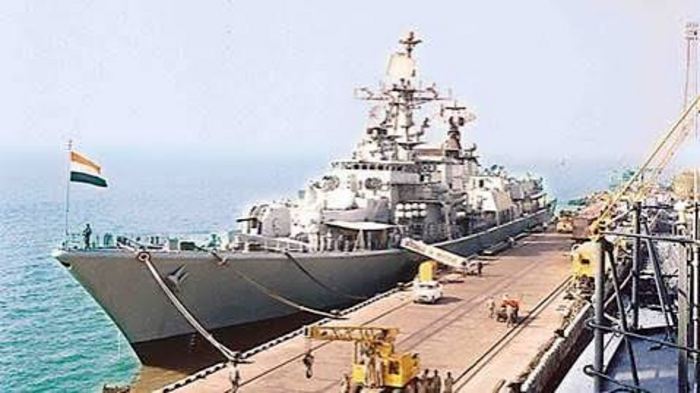
The India-Japan defence ties are entering a stronger phase, with both countries realising the importance of closer ties for the joint production of warships to bolster maritime power in the changing geopolitical landscape as China increasingly flexes its naval muscle, according to a new report.
Recent developments such as the transfer of Japan’s advanced Unified Complex Radio Antenna (UNICORN) mast technology to the Indian Navy, Japan’s relaxation of its arms exports policy, and discussions on co-developing Mogami-class frigates suggest that the future of India-Japan security cooperation also lies in the shipyards, according to an article in The Diplomat.

The UNICORN agreement serves as proof that India and Japan can move beyond a conventional buyer-seller relationship toward more collaborative defence production. The logical next step here is shipbuilding.
India is a trusted strategic partner for Japan with an expanding defence industrial base capable of supporting larger collaborative projects, the article observes.
For India, which seeks to modernise its naval capabilities while advancing the objectives of Aatmanirbhar Bharat, access to Japanese technologies will give a booster shot to indigenous shipbuilding.
This need for enhancing bilateral defence industrial cooperation was also highlighted during Japanese Prime Minister Sanae Takaichi’s visit to India earlier this month.
“Joint shipbuilding creates long-term industrial linkages that involve advanced manufacturing, electronics, propulsion systems, artificial intelligence, and maintenance ecosystems. Such cooperation also strengthens both military capability and economic resilience,” the article states.
It highlights the Japan’s proposal to jointly develop and produce the advanced Mogami-class frigates with India deserves serious consideration. The Mogami class represents one of the most modern multi-mission frigates which combines stealth features, high levels of automation and anti-submarine warfare capabilities.
The article underscores that this closer partnership in defence manufacturing represents a win-win situation for both countries.
Indian shipyards have already progressed in the design and construction of destroyers, frigates, and offshore patrol vessels. Japan’s expertise in automation, integrated ship systems, and advanced maritime electronics could enhance India’s next generation of naval platforms, the article states.
Japan also stands to benefit as despite possessing world-class maritime technologies, Japanese defence companies are constrained by a relatively small domestic market. Therefore, partnering with India would provide greater production scale, strengthen supply-chain resilience and support long-term sustainability of Japan’s defense industrial base, the article observes.
Strategically, India-Japan shipbuilding cooperation would also deepen the regional maritime balance. Both countries occupy a crucial position along the Indo-Pacific’s critical sea lanes and share an interest in preserving freedom of navigation, respect for international law and a rules-based maritime order.
Jointly developing naval platforms would iprove interoperability across a range of missions, including anti-submarine warfare, humanitarian assistance and disaster relief, and the protection of critical sea lines of communication, the article added.