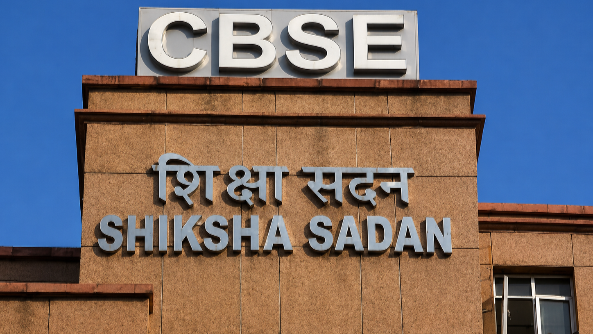
The Supreme Court asked the CBSE to explore a one-year exemption for Class 6 students from the board's newly introduced three-language requirement, while deferring further hearing in the matter to Sept 17.
A three-judge bench headed by Chief Justice of India Surya Kant, along with Justices Joymalya Bagchi and V Mohana, made the suggestion while hearing a batch of petitions challenging the Central Board of Secondary Education's three-language policy.

“Consider Class 6 for this year… If they can be given some accommodation,” the bench told Solicitor General Tushar Mehta.
Mehta sought an adjournment because Additional Solicitor General Aishwarya Bhati, who was representing the matter, was unavailable. He assured the court that the concerned officials would examine the suggestion.
“All of us would sit together and revert to your lordship,” the solicitor general said.
A senior counsel representing one of the petitioners opposed further delays, pointing out that students are required to appear for examinations and that repeated adjournments were increasing anxiety among parents.
The petitions challenge the CBSE's decision to require Class 9 students to study three languages from July 1, including at least two native Indian languages.
During an earlier hearing on Aug 20, the Supreme Court had called for a solution to concerns surrounding the policy and said students should not be placed under unnecessary pressure.
The court had also observed that there was no issue with introducing the three-language system itself, but concerns had been raised over the way it was being implemented.
The bench had also highlighted the need to develop sufficient human resources to support the different language choices available to students.
“If you have chosen Class 6 as the starting point, you may consider giving a reprieve to Class 6 students of this year. You can introduce it from next year,” it had said.
One of the petitioners' senior counsel has argued that CBSE lacks the jurisdiction to frame the curriculum for Classes 6 to 8, contending that the responsibility lies with the National Council of Educational Research and Training (NCERT).
The Supreme Court had agreed on May 27 to hear a challenge to the policy and issued notices to the Centre, CBSE and NCERT seeking their responses.
Under a CBSE circular, Class 9 students are required to study three languages from July 1, with at least two required to be native Indian languages.
The policy forms part of the board's efforts to align its academic structure with the National Education Policy (NEP) 2020 and the National Curriculum Framework for School Education (NCF-SE), 2023.
A May 15 circular stated that students choosing a foreign language can select it as a third language only after studying two native Indian languages. Alternatively, a foreign language can be taken as a fourth language.