Escalating US-Israel-Iran conflict fuels global risk aversion, strengthening the dollar and pressuring emerging market currencies.

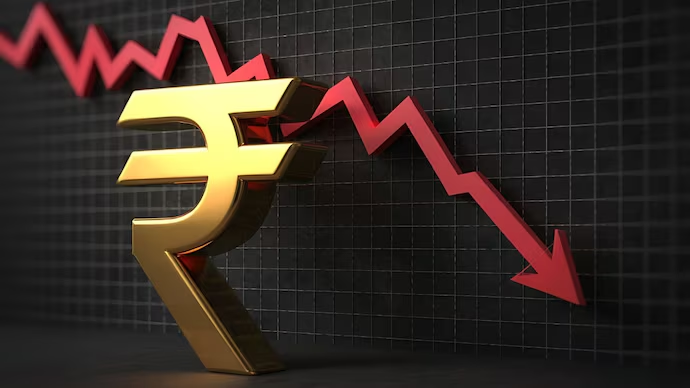
The Indian rupee tumbled to a historic low of ₹92.17 against the US dollar on March 4 as rising geopolitical tensions and surging crude oil prices rattled global financial markets. Investors’ flight to safety amid the escalating conflict involving the United States, Israel, and Iran intensified pressure on the currency.
A sharp rise in crude oil prices, driven by fears of supply disruptions in the Middle East—a key energy-exporting region—further exacerbated the rupee’s decline. India imports nearly 85% of its crude oil, making the economy highly sensitive to sustained oil price increases. Higher import costs risk widening the current account deficit, stoking inflation, and slowing economic growth, all of which weigh on the rupee.

The US dollar’s strength added to the currency’s vulnerability. As geopolitical uncertainty spiked, global investors sought the safety of the dollar and US Treasury bonds, triggering capital outflows from emerging markets. This trend put additional downward pressure on the rupee and other regional currencies.
Global financial markets mirrored this volatility. Asian equities fell sharply after losses on Wall Street, while currency markets reacted swiftly to Middle East developments. Analysts warn that the rupee’s trajectory in the coming days will be closely tied to oil price movements and any further escalation in geopolitical tensions.

India’s Blue Economy Push Seeks to Balance Growth and Ocean Conservation

Supreme Court Seeks Panel to Curb Unethical Pharma Marketing Practices

NMC Tightens Rules on Doctors’ Digital Advertising and AI Use

Anthropic Launches Claude Haiku 5.5 as Its Fastest and Cheapest AI Model

Karnataka HC Replaces ‘Visitation’ with ‘Parenting Time’ in Child Custody Cases

Canadian author Anne Carson wins 2026 Nobel Prize in Literature for reshaping contemporary literary forms

AMU students’ protest enters third week as union election demand widens

DPDP Act Explained: What is India’s Digital Personal Data Protection Law and Why is it in the News?

IIT Bombay puts stricter cheating rules on hold, drafts new procedure for exam misconduct

Gujarat launches PARAKH Cell to shift school assessments toward competency-based learning

India’s Blue Economy Push Seeks to Balance Growth and Ocean Conservation

Supreme Court Seeks Panel to Curb Unethical Pharma Marketing Practices

NMC Tightens Rules on Doctors’ Digital Advertising and AI Use

Anthropic Launches Claude Haiku 5.5 as Its Fastest and Cheapest AI Model

Karnataka HC Replaces ‘Visitation’ with ‘Parenting Time’ in Child Custody Cases

Canadian author Anne Carson wins 2026 Nobel Prize in Literature for reshaping contemporary literary forms

AMU students’ protest enters third week as union election demand widens

DPDP Act Explained: What is India’s Digital Personal Data Protection Law and Why is it in the News?

IIT Bombay puts stricter cheating rules on hold, drafts new procedure for exam misconduct

Gujarat launches PARAKH Cell to shift school assessments toward competency-based learning
Copyright© educationpost.in 2024 All Rights Reserved.
Designed and Developed by @Pyndertech