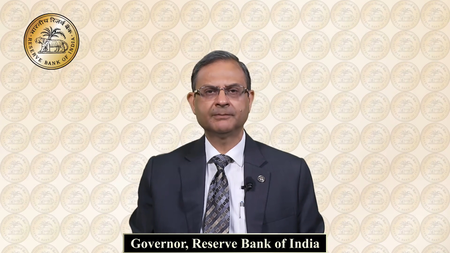
Governor Sanjay Malhotra says polymer notes are under preliminary review, with the RBI assessing benefits and challenges while assuring adequate cash supply across the banking system.

The Reserve Bank of India (RBI) is examining a proposal to introduce polymer or plastic currency notes, although no final decision has been taken yet, Governor Sanjay Malhotra has said.
Malhotra has said that the proposal remains under consideration and is still at a preliminary stage.

He stated that as far as polymer notes are concerned, the proposal is under consideration, adding that as soon as any decision is taken on it, we will inform you.
Malhotra acknowledged that recent reports regarding polymer notes contain some truth but clarified that the central bank has not reached any conclusion so far.
“We are examining the pros and cons of it and whether it would be worthwhile to implement. It is still at a preliminary stage,” he said.
Moreover, the central bank is currently evaluating both the potential advantages and challenges associated with polymer currency before deciding whether to proceed with its introduction.
In addition, the RBI Governor assured that adequate currency is available in the banking system and said the central bank is prepared to respond quickly if localized shortages arise.
“If there is a shortage, we will certainly ensure that the shortage is met,” he said.
Stressing that sufficient currency stock is available for ATMs and bank branches, Malhotra said the RBI would ensure rapid replenishment wherever required.
“Our full effort will be to ensure that wherever there is a shortage of currency in one or two places at ATMs, we will deliver currency there promptly and at a rapid pace,” he added.
The remarks come as the RBI reviews the feasibility of polymer notes while maintaining that adequate cash remains available for distribution across the banking system.

India’s Blue Economy Push Seeks to Balance Growth and Ocean Conservation

Supreme Court Seeks Panel to Curb Unethical Pharma Marketing Practices

NMC Tightens Rules on Doctors’ Digital Advertising and AI Use

Anthropic Launches Claude Haiku 5.5 as Its Fastest and Cheapest AI Model

Karnataka HC Replaces ‘Visitation’ with ‘Parenting Time’ in Child Custody Cases

Canadian author Anne Carson wins 2026 Nobel Prize in Literature for reshaping contemporary literary forms

AMU students’ protest enters third week as union election demand widens

DPDP Act Explained: What is India’s Digital Personal Data Protection Law and Why is it in the News?

IIT Bombay puts stricter cheating rules on hold, drafts new procedure for exam misconduct

Gujarat launches PARAKH Cell to shift school assessments toward competency-based learning

India’s Blue Economy Push Seeks to Balance Growth and Ocean Conservation

Supreme Court Seeks Panel to Curb Unethical Pharma Marketing Practices

NMC Tightens Rules on Doctors’ Digital Advertising and AI Use

Anthropic Launches Claude Haiku 5.5 as Its Fastest and Cheapest AI Model

Karnataka HC Replaces ‘Visitation’ with ‘Parenting Time’ in Child Custody Cases

Canadian author Anne Carson wins 2026 Nobel Prize in Literature for reshaping contemporary literary forms

AMU students’ protest enters third week as union election demand widens

DPDP Act Explained: What is India’s Digital Personal Data Protection Law and Why is it in the News?

IIT Bombay puts stricter cheating rules on hold, drafts new procedure for exam misconduct

Gujarat launches PARAKH Cell to shift school assessments toward competency-based learning
Copyright© educationpost.in 2024 All Rights Reserved.
Designed and Developed by @Pyndertech