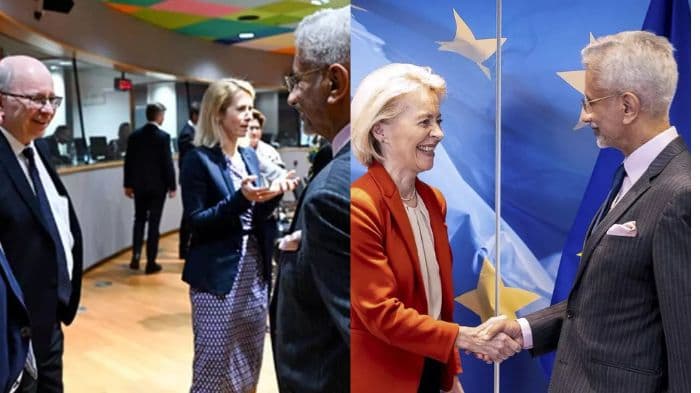
External Affairs Minister S Jaishankar held discussions with EU leaders in Brussels, highlighting the vast economic opportunities under the India-EU free trade agreement and pushing for deeper cooperation across trade, technology and strategic sectors.

External Affairs Minister S Jaishankar held discussions with leaders of the European Union, underlining the “enormous economic potential” of the recently concluded India-EU free trade agreement (FTA).
During his visit to Brussels, Jaishankar engaged with senior EU leadership and foreign ministers of member states, focusing on advancing the implementation of the landmark trade pact and expanding cooperation across key sectors.

He emphasised that the FTA is not just a trade arrangement but a foundation for a broader partnership that includes technology, mobility, security and supply chain resilience.
The India-EU FTA, finalised in January 2026 after nearly two decades of negotiations, is one of the most significant trade agreements for both sides. It aims to reduce or eliminate tariffs on a wide range of goods and boost bilateral trade and investment flows.
Officials say the agreement is expected to enhance market access for Indian exporters in sectors such as textiles, engineering goods and pharmaceuticals, while also opening up opportunities for European companies in India.
Jaishankar also highlighted the strategic importance of stronger India-EU ties in the current global environment, where countries are looking to diversify trade partnerships amid geopolitical uncertainties.
The discussions come at a time when both India and the EU are seeking to deepen engagement beyond trade, including in areas like critical minerals, digital cooperation and defence partnerships.
The visit is seen as part of ongoing efforts to operationalise the agreement and translate it into tangible economic gains, with both sides working to finalise implementation mechanisms and timelines.

India’s Blue Economy Push Seeks to Balance Growth and Ocean Conservation

Supreme Court Seeks Panel to Curb Unethical Pharma Marketing Practices

NMC Tightens Rules on Doctors’ Digital Advertising and AI Use

Anthropic Launches Claude Haiku 5.5 as Its Fastest and Cheapest AI Model

Karnataka HC Replaces ‘Visitation’ with ‘Parenting Time’ in Child Custody Cases

Canadian author Anne Carson wins 2026 Nobel Prize in Literature for reshaping contemporary literary forms

AMU students’ protest enters third week as union election demand widens

DPDP Act Explained: What is India’s Digital Personal Data Protection Law and Why is it in the News?

IIT Bombay puts stricter cheating rules on hold, drafts new procedure for exam misconduct

Gujarat launches PARAKH Cell to shift school assessments toward competency-based learning

India’s Blue Economy Push Seeks to Balance Growth and Ocean Conservation

Supreme Court Seeks Panel to Curb Unethical Pharma Marketing Practices

NMC Tightens Rules on Doctors’ Digital Advertising and AI Use

Anthropic Launches Claude Haiku 5.5 as Its Fastest and Cheapest AI Model

Karnataka HC Replaces ‘Visitation’ with ‘Parenting Time’ in Child Custody Cases

Canadian author Anne Carson wins 2026 Nobel Prize in Literature for reshaping contemporary literary forms

AMU students’ protest enters third week as union election demand widens

DPDP Act Explained: What is India’s Digital Personal Data Protection Law and Why is it in the News?

IIT Bombay puts stricter cheating rules on hold, drafts new procedure for exam misconduct

Gujarat launches PARAKH Cell to shift school assessments toward competency-based learning
Copyright© educationpost.in 2024 All Rights Reserved.
Designed and Developed by @Pyndertech