Union government stresses procedural rigor, says medical device classification lies with Health Ministry — not GST Council.

In a firm rebuttal before the Delhi High Court, the union government opposed a Public Interest Litigation seeking a reduction in GST on air purifiers and their reclassification as “medical devices.” The government underscored that such classification falls under the Health Ministry’s domain following detailed scrutiny, and not the GST Council’s jurisdiction.
Additional Solicitor General N Venkataraman argued that no urgent GST Council meeting has been convened to discuss this matter, and the petition’s demand to expedite a tax cut disregards the constitutional process. “The GST Council is a federal body involving all states, and decisions require physical meetings and proper procedure,” he emphasized, requesting the court grant two more days to file a comprehensive affidavit.

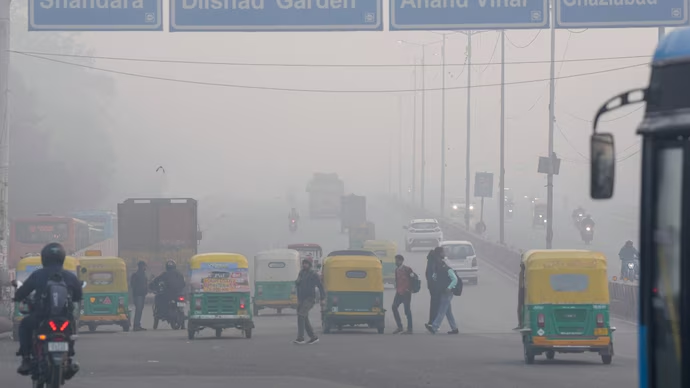
The plea gained momentum amid Delhi’s deteriorating air quality, prompting the court to urge the GST Council to hold an urgent session on December 24. However, the union government cautioned that acting hastily could “open a Pandora’s box,” pointing to ongoing parliamentary committee recommendations and constitutional complexities.
“The process cannot be scuttled,” the ASG told the bench, signaling that any decision on GST adjustments must respect legal protocols, rather than be rushed by public pressure or litigation.

India’s Blue Economy Push Seeks to Balance Growth and Ocean Conservation

Supreme Court Seeks Panel to Curb Unethical Pharma Marketing Practices

NMC Tightens Rules on Doctors’ Digital Advertising and AI Use

Anthropic Launches Claude Haiku 5.5 as Its Fastest and Cheapest AI Model

Karnataka HC Replaces ‘Visitation’ with ‘Parenting Time’ in Child Custody Cases

Canadian author Anne Carson wins 2026 Nobel Prize in Literature for reshaping contemporary literary forms

AMU students’ protest enters third week as union election demand widens

DPDP Act Explained: What is India’s Digital Personal Data Protection Law and Why is it in the News?

IIT Bombay puts stricter cheating rules on hold, drafts new procedure for exam misconduct

Gujarat launches PARAKH Cell to shift school assessments toward competency-based learning

India’s Blue Economy Push Seeks to Balance Growth and Ocean Conservation

Supreme Court Seeks Panel to Curb Unethical Pharma Marketing Practices

NMC Tightens Rules on Doctors’ Digital Advertising and AI Use

Anthropic Launches Claude Haiku 5.5 as Its Fastest and Cheapest AI Model

Karnataka HC Replaces ‘Visitation’ with ‘Parenting Time’ in Child Custody Cases

Canadian author Anne Carson wins 2026 Nobel Prize in Literature for reshaping contemporary literary forms

AMU students’ protest enters third week as union election demand widens

DPDP Act Explained: What is India’s Digital Personal Data Protection Law and Why is it in the News?

IIT Bombay puts stricter cheating rules on hold, drafts new procedure for exam misconduct

Gujarat launches PARAKH Cell to shift school assessments toward competency-based learning
Copyright© educationpost.in 2024 All Rights Reserved.
Designed and Developed by @Pyndertech